
The best software for implementing and maintaining ISO 14001:2026 is Manglai, Enablon, SpheraCloud, Quentic, Intelex, EcoGestor Legislación and IsoMetrix. Manglai tops the list because it brings water, waste and emissions into a single auditable workflow with full evidence traceability.
What changes with ISO 14001:2026 and how long your certificate lasts
The new edition of the standard, ISO 14001:2026, was published on 15 April 2026 and replaces the 2015 version and its 2024 climate change amendment. The changes that most affect the software decision are these:
- The term legal and other requirements is replaced by compliance obligations, with a more structured approach to identifying, evaluating and continuously evidencing compliance.
- Climate change moves firmly into context analysis, alongside biodiversity, pollution and the availability of natural resources.
- The life cycle perspective is strengthened: environmental aspects must be assessed across the value chain, not only in your own operations.
- A specific change management requirement appears, and environmental aspects are more clearly separated from business risks and opportunities.
- Greater weight on leadership and on integrating the system into strategy, plus defined objectives for the internal audit.
The deadline matters: the IAF opened a 36-month transition period, and certificates issued under ISO 14001:2015 cease to be valid on 30 April 2029. The full breakdown is in the article on the new ISO 14001:2026, and the comparison with what was audited under the previous edition is in the ISO 14001:2015 audit checklist.
ISO 14001 software compared
| Tool | Best for | What it covers of the management system | Standards | Deployment | Spanish version and local support | Pricing model |
|---|---|---|---|---|---|---|
| Manglai | Sustainability teams that run the EMS on environmental data | Indicators, evidence, water, waste, emissions and ESRS reporting | ISO 14001, ISO 14046, ISO 14064, ESRS | SaaS, fast implementation | Yes, product and support in Spanish | Starter, Pro and Enterprise plans, price on request |
| Enablon (Wolters Kluwer) | Large enterprises with the EMS embedded in EHS and compliance | Incidents, audits, permits, risk and ESG | ISO 14001, ISO 45001 | Corporate programme, long implementation | Multilingual | No published prices |
| SpheraCloud (Sphera) | Organisations with technical LCA and risk teams | Operational risk, LCA and product stewardship | ISO 14001, ISO 14040 and 14044 | SaaS plus desktop software | Multilingual | No published prices |
| Quentic (AMCS group) | Industry integrating environment, safety and quality | Document control, incidents, waste and legal compliance | ISO 14001, ISO 45001, ISO 50001 | Modular SaaS | Yes, with European presence | No published prices |
| Intelex | Multinational corporations with complex audit processes | Audits, workflows and document management | ISO 14001, ISO 45001, ISO 9001 | Configurable SaaS | Multilingual | No published prices |
| EcoGestor Legislación (Eurofins) | Companies in Spain that need to cover their compliance obligations | Identification and evaluation of applicable legal requirements | ISO 14001, EMAS, ISO 45001, ISO 50001 | SaaS | Yes, Spanish legal database and Spanish-speaking support | No published prices |
| IsoMetrix | Heavily regulated sectors such as mining and energy | Risk, environmental performance and ESG governance | ISO 14001, GRI | Highly configurable SaaS | Mainly English | No published prices |
What does ISO 14001 require in practice?
The standard sets out the requirements for an environmental management system based on continual improvement. To comply today, a company has to demonstrate real control over its significant environmental aspects, full traceability of evidence and a systematic capacity for data analysis. That means measuring consumption, generating indicators, planning objectives, assessing risks, running internal audits and documenting the processes.
Certification is increasingly hard to sustain with manual procedures. Not because the standard requires software, which it does not, but because the variability of environmental data and the need to demonstrate compliance year after year call for consistency and traceability. Add to that the fragmentation of Spanish regulation, where state, regional and municipal obligations coexist, as shown in the analysis of environmental legislation at regional level in Spain. If your management system is heading toward EMAS verification, the documentary requirements are higher still.
Which is the best software for ISO 14001?
1. Manglai
Best for: sustainability and environment teams that need to support the EMS with real water, waste and emissions data, and want the same system to serve both the standard's audit and ESRS reporting.

Strengths:
- Full traceability, from the indicator to the evidence behind it.
- Water footprint aligned with ISO 14046, with geographic factors and basin analysis.
- Waste management with traceability by waste manager, waste code and treatment route.
- Emissions inventory aligned with ISO 14064, with reports suitable for external verification.
- Automated reporting for CSRD and ESRS E2 to E5.
- Guided workflows that cut the time spent preparing audits, with an interface designed for non-technical teams.
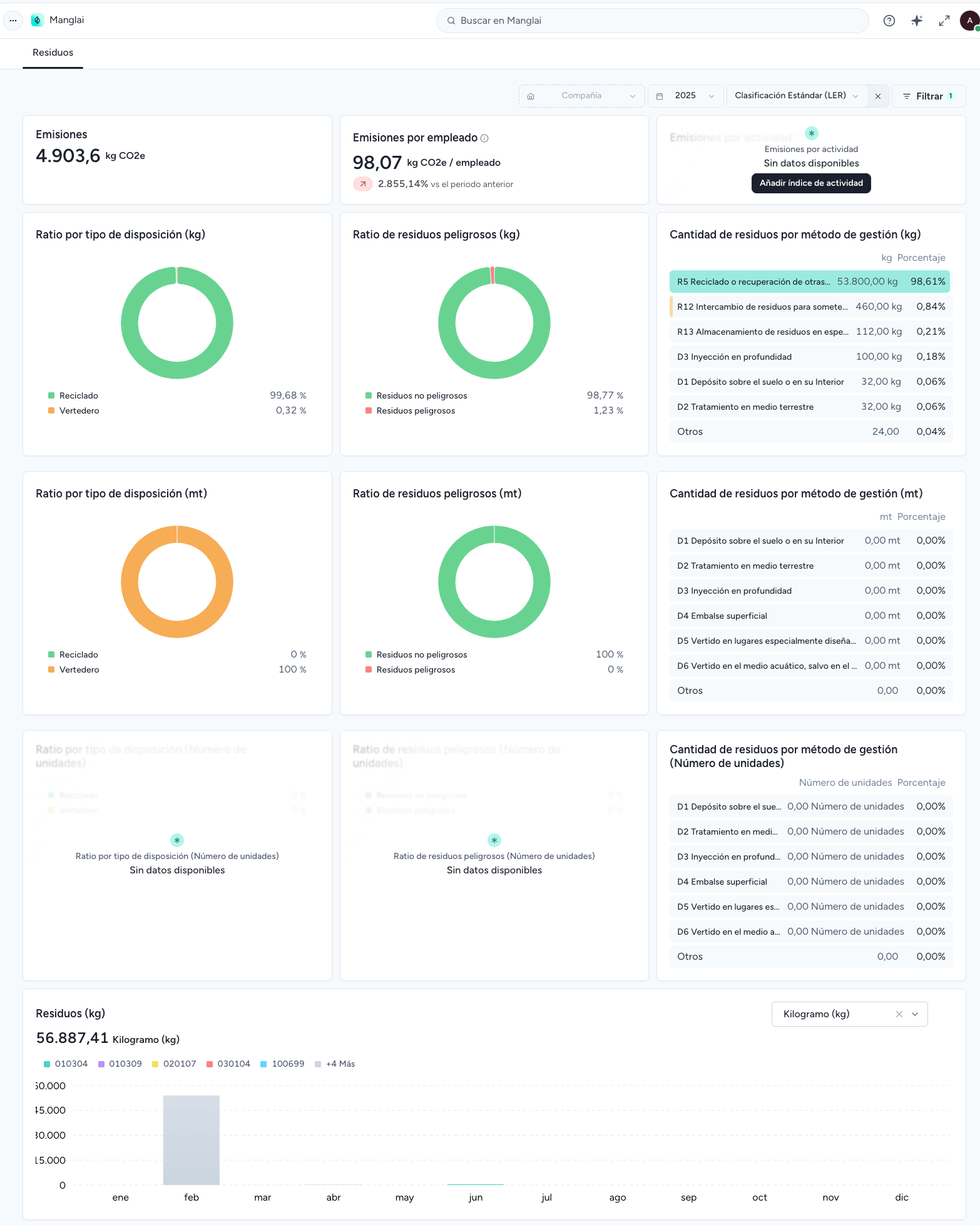
The proposition is backed by real traction: active clients in 70 countries, more than 30,000 users and 25 million tonnes of CO2e managed, with an average rating of 4.7 out of 5.
Honest limitation: it is not a full EHS system. If your EMS needs safety incident management, complex industrial permitting or occupational health audits, it has to be paired with an EHS tool. It also does not cover extremely specialised water modelling, as required in mining or certain chemical processes, although in those cases it usually works as the environmental governance core.
2. Enablon (Wolters Kluwer)
Best for: large enterprises that want an EMS fully integrated with EHS, risk and legal compliance.
Strengths: established, robust platform, configurable modules for large corporations and advanced incident and audit management.
Honest limitation: high cost, long implementation and less specific water footprint capabilities than dedicated tools. It does not publish prices.
3. SpheraCloud (Sphera)
Best for: organisations with technical teams focused on life cycle assessment, impact modelling and advanced environmental management.
Strengths: extensive libraries, proven methodologies and strong LCA support, including water-related impacts. A good fit for chemicals, complex manufacturing and energy.
Honest limitation: requires technical profiles and is not the lightest option for a small company. It does not publish prices.
4. Quentic (AMCS group)
Best for: organisations that need to integrate ISO 14001, occupational risk prevention and legal compliance in one system. It belongs to the AMCS group and keeps its own brand and product.
Strengths: good user experience, solid document control and a strong fit for regulated industries.
Honest limitation: water footprint measurement is not its focus, and additional modules are usually needed to cover the whole EMS. It does not publish prices.
5. Intelex
Best for: multinational corporations with complex audit processes and an established compliance structure.
Strengths: global scalability, automated audits and workflows, and advanced customisation.
Honest limitation: steep learning curve and an architecture designed for large organisations. It does not publish prices.
6. EcoGestor Legislación (Eurofins)
Best for: companies operating in Spain whose weak point at audit is identifying and evaluating legal requirements, which is exactly what the 2026 edition reframes as compliance obligations.
Strengths: a legal database kept up to date at European, national, regional and municipal level, coverage of ISO 14001, EMAS, ISO 45001 and ISO 50001, and product and support in Spanish.
Honest limitation: it covers legal compliance, not environmental measurement or ESRS reporting. It works as a complement to a data platform, not a replacement. It does not publish prices.
7. IsoMetrix
Best for: companies in heavily regulated sectors combining EMS, risk and ESG governance with extensive customisation.
Strengths: deep integration between risk, environmental performance and reporting.
Honest limitation: long deployment, high cost and a product aimed mainly at English-speaking markets. It does not publish prices.
How to choose ISO 14001 software
1. Coverage of compliance obligations. The 2026 edition raises the bar here. Check how the tool maintains the list of applicable legal requirements and how it evidences their periodic evaluation.
2. Methodological rigour. ISO 14046 for water, ISO 14064 for emissions and the ESRS for reporting. If the calculation cannot withstand an external audit, nothing else matters.
3. Traceability and verifiable evidence. Every indicator must link to invoices, waste certificates, laboratory reports, meter readings or permits, with versioning and change history.
4. Integration and scalability. ERP, energy platforms, sensors, waste databases and maintenance systems. Consolidating sites without losing the detail of each one is what separates a corporate tool from a shared spreadsheet.
5. Usability and internal adoption. Technically impeccable software still fails if the team does not use it. Workflows must resemble how operations and environment teams actually work.
6. Total cost of ownership. Licence, implementation, integrations, training and internal hours in the first year. Almost no vendor in this market publishes prices, so ask for the three-year cost.
Which software to choose in your situation
- SME or mid-market company that wants to certify or migrate to the 2026 edition with tidy data: Manglai.
- Multi-site group with an established EHS function: Enablon or Intelex.
- Chemical or energy company with a technical team: SpheraCloud.
- Company integrating environment and occupational safety in one system: Quentic.
- Organisation with recurring legal-requirement findings: EcoGestor Legislación, alongside a measurement platform.
- Company needing external verification of environmental data: prioritise traceability, versioning and evidence export above any other feature.
What role does the water footprint play in ISO 14001?
ISO 14001 is a general standard, but in Spain auditors prioritise critical indicators such as the corporate water footprint, basin-level risk analysis and water-use traceability. Pressure on several river basins has made water a strategic parameter, and the 2026 edition reinforces that angle by adding the availability of natural resources to context analysis.
In practice the system must capture direct and indirect consumption, evaporation, returns to the environment and internal reuse, and assess the real impact of water use on local availability, which is what the ISO 14046 methodology provides. Digitalising it reduces the most common audit deviations: incomplete data, discrepancies between sites and conversion errors. For a more methodological read, there is the article on water neutrality in Spanish industry.
How to start digitalising ISO 14001
- Define the environmental scope: which indicators need digitalising across water, waste, emissions and energy.
- Organise the compliance obligations: a list of applicable legal requirements per site, with an owner and a date of last evaluation.
- Select a pilot site: it reduces the initial investment and lets you validate the approach before scaling.
- Load a full year of real data into the candidate tool and check whether you can trace any figure back to its evidence.
- Scale to the rest of the system: sites, suppliers and the remaining environmental areas, once the workflow is validated.
With the transition to the 2026 edition open until April 2029, there is room to get the data in order, but it goes quickly. To see how the EMS fits into a single environmental system, the environmental management software comparison covers the remaining areas, and Manglai's carbon footprint platform is the usual entry point.
Frequently asked questions about ISO 14001 software
Do I need software to obtain ISO 14001?
It is not mandatory. The standard does not require any particular tool, but the complexity of reporting and audit requirements make digital support highly advisable to sustain the system.
What changes with ISO 14001:2026?
It replaces legal requirements with compliance obligations, brings climate change and biodiversity into context analysis, strengthens the life cycle perspective and adds a change management requirement.
How long is my 2015 certificate valid?
Until 30 April 2029. After that date, certificates issued under ISO 14001:2015 are no longer valid.
Can I use the same software for ISO 14001 and the CSRD?
Yes, if you choose a platform that already integrates ESRS E2 pollution, E3 water and marine resources and E5 resource use and circular economy metrics with the same traceability the standard requires.
What if I have several sites with different consumption levels?
Current tools consolidate and compare sites without losing individual detail, which is where data audit errors usually appear.