The most complete platforms to measure a corporate carbon footprint in 2026 are Manglai, SAP Sustainability Footprint Management, Sphera LCA for Experts, One Click LCA, Ecochain, CarbonCloud and Carbonfact. Manglai leads the comparison for companies reporting in Spain and southern Europe thanks to its scope 1, 2 and 3 coverage, audit-ready reports and Spanish-language platform.
Measuring the carbon footprint is no longer a reputational exercise. In Spain, Royal Decree 214/2025 requires companies in its scope to calculate their carbon footprint and to publish an emissions reduction plan. Scopes 1 and 2 are mandatory and scope 3 is voluntary. Registration in the MITECO carbon footprint registry remains voluntary for private companies.
At European level, following Directive (EU) 2026/470 of the Omnibus package, sustainability reporting obligations now concentrate on companies with more than 1,000 employees and 450 million euros in net turnover, applying to financial years starting on or after 1 January 2027. Every other company still receives emissions data requests from clients, banks and public tenders.
The challenge is not only collecting the data, but doing it with a tool that guarantees methodological rigour, data traceability and integration with the systems the company already uses.
What is the carbon footprint and why is it essential to measure it?
The carbon footprint represents the total amount of greenhouse gases (GHG) emitted, directly or indirectly, by an organisation, activity or product. It is measured in tonnes of CO₂ equivalent (tCO₂e) and helps identify the main emission hotspots in order to reduce them strategically.
According to the GHG Protocol, there are three levels or scopes of emissions:
- Scope 1: direct emissions from owned or controlled operations (fuels, vehicles, machinery).
- Scope 2: indirect emissions from purchased electricity, heat or steam.
- Scope 3: indirect emissions throughout the value chain (suppliers, logistics, travel, waste and others).
If you want to explore this third and most complex level, read our practical guide to Scope 3 of the GHG Protocol.
Accurately measuring your carbon footprint not only ensures regulatory compliance but also strengthens brand reputation, supports sustainable decision-making and can ease access to green financing.
What criteria should you use to choose carbon footprint software?
Selecting the right software can be the difference between a superficial estimate and a verifiable emissions inventory. These are the six criteria worth checking before you decide:
- Recognised methodology: alignment with the GHG Protocol, ISO 14064-1 and European reporting frameworks (ESRS E1, PEF).
- Data quality and coverage: updated, documented emission factors adapted to different sectors and geographies.
- Automation: the ability to import energy use, mobility or supplier data from ERP systems, invoices or spreadsheets.
- Traceability and auditability: a record of sources, evidence and methodological changes so every figure can be defended in front of an external verifier.
- Scalability: the ability to move from a pilot to consolidated reporting across several sites, countries and legal entities without breaking year-on-year consistency.
- Total cost of ownership: licences, support, training and implementation time. Worth noting: as of August 2026, almost none of the platforms in this comparison publishes fixed pricing on its website. Ecochain is the exception, with plans starting at 290 euros per month; all the others quote on request.
Comparison of the 7 best carbon footprint software tools
| Tool | Best for | Scopes and frameworks | Deployment | Spanish-language interface | Pricing model |
|---|---|---|---|---|---|
| Manglai | SMEs and mid-sized groups reporting in Spain without a dedicated technical team | Scopes 1, 2 and 3; GHG Protocol, ISO 14064-1, ESRS E1 and the MITECO registry | SaaS with guided implementation | Yes, platform and support in Spanish | Starter, Pro and Enterprise plans; price on request |
| SAP Sustainability Footprint Management | Corporations already running SAP S/4HANA | Scopes 1, 2 and 3 calculated from ERP transactional data | Module inside the SAP ecosystem | Not stated on its website | No public pricing |
| Sphera LCA for Experts (formerly GaBi) | Industrial companies with complex life cycle assessment needs | Full LCA, product carbon footprint and EPDs | Specialist software, usually with consulting | Not stated on its website | No public pricing |
| One Click LCA | Construction, infrastructure and manufacturing | 140+ LCA and EPD standards and methods, 500,000+ datasets | SaaS with BIM integrations | Not stated on its website | No public pricing |
| Ecochain | Industrial manufacturers producing many environmental declarations | LCA, EPD and product carbon footprint (PCF) | SaaS | Not stated on its website | Publishes pricing: Professional from 290 euros per month and Business from 640 euros per month; its site cites an average cost of 50 euros per LCA at scale |
| CarbonCloud | Food and beverage | Product and food supply chain footprint | SaaS | Not stated on its website | No public pricing |
| Carbonfact | Fashion, footwear, textiles, leather and luxury | 16 PEFCR indicators, French Eco-Score, CSRD and digital product passport | SaaS | Not stated on its website | No public pricing |
Which is the best software to calculate the carbon footprint?
Choosing the best carbon footprint software depends on your company's needs, size and climate maturity. Some solutions are designed for large corporations with dedicated sustainability teams, while others, such as Manglai, offer a practical and accessible approach for organisations seeking fast, verifiable results.
Below we analyse each option in the same format: who it is for, strengths and one honest limitation.
1. Manglai: fast, rigorous and ready-to-communicate measurement
Best for: companies that need to calculate their full carbon footprint (scopes 1, 2 and 3) and report it in Spain without relying on external consultancies.
Manglai combines technical precision with ease of use to calculate the carbon footprint comprehensively.
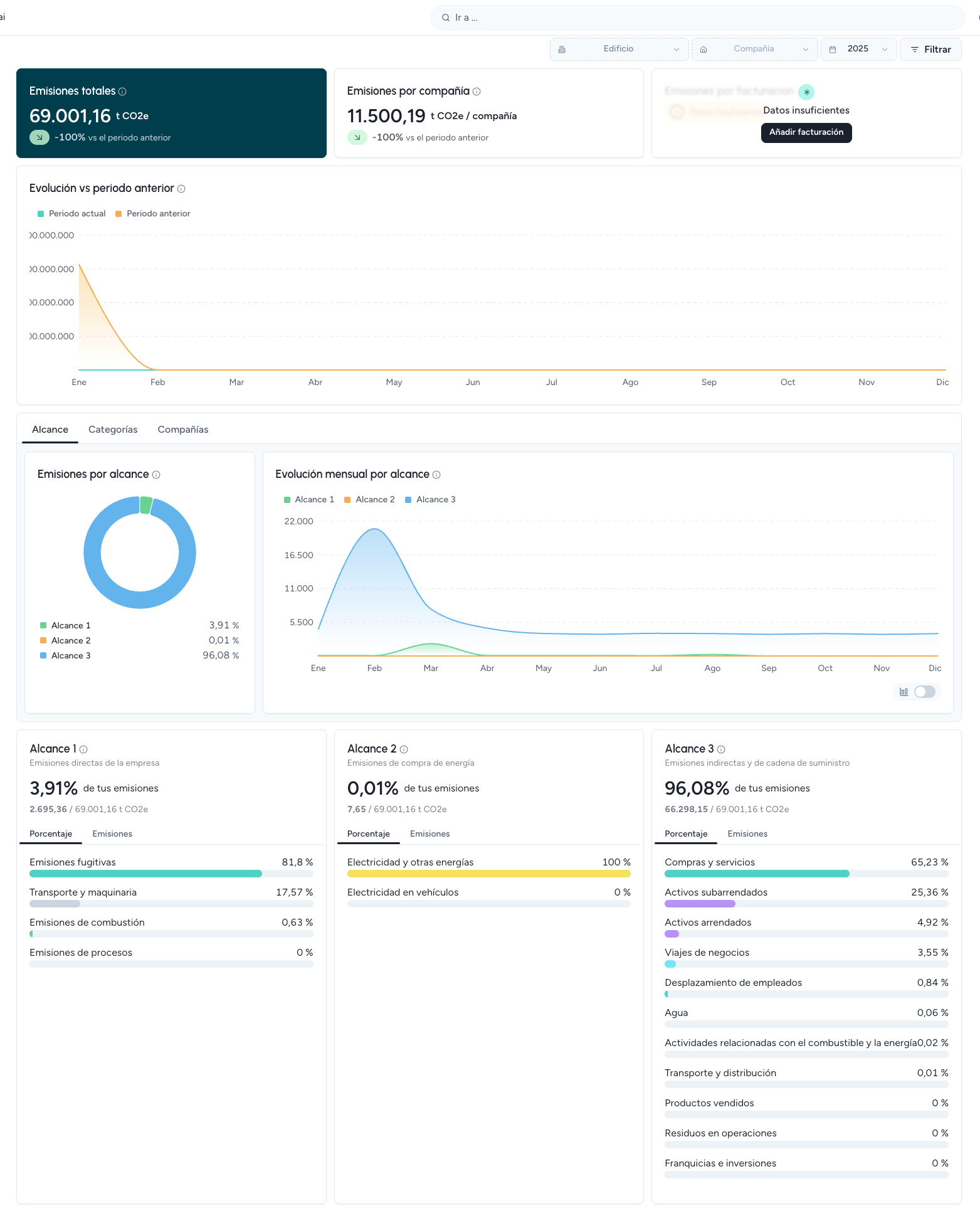
Strengths:
- Guided workflow: the tool walks users through each step of the process, minimising errors and omissions.
- Verified databases: emission factors aligned with international sources such as DEFRA, IPCC and Ecoinvent.
- Results visualisation: dashboards and charts that make it easy to present outcomes to management and stakeholders.
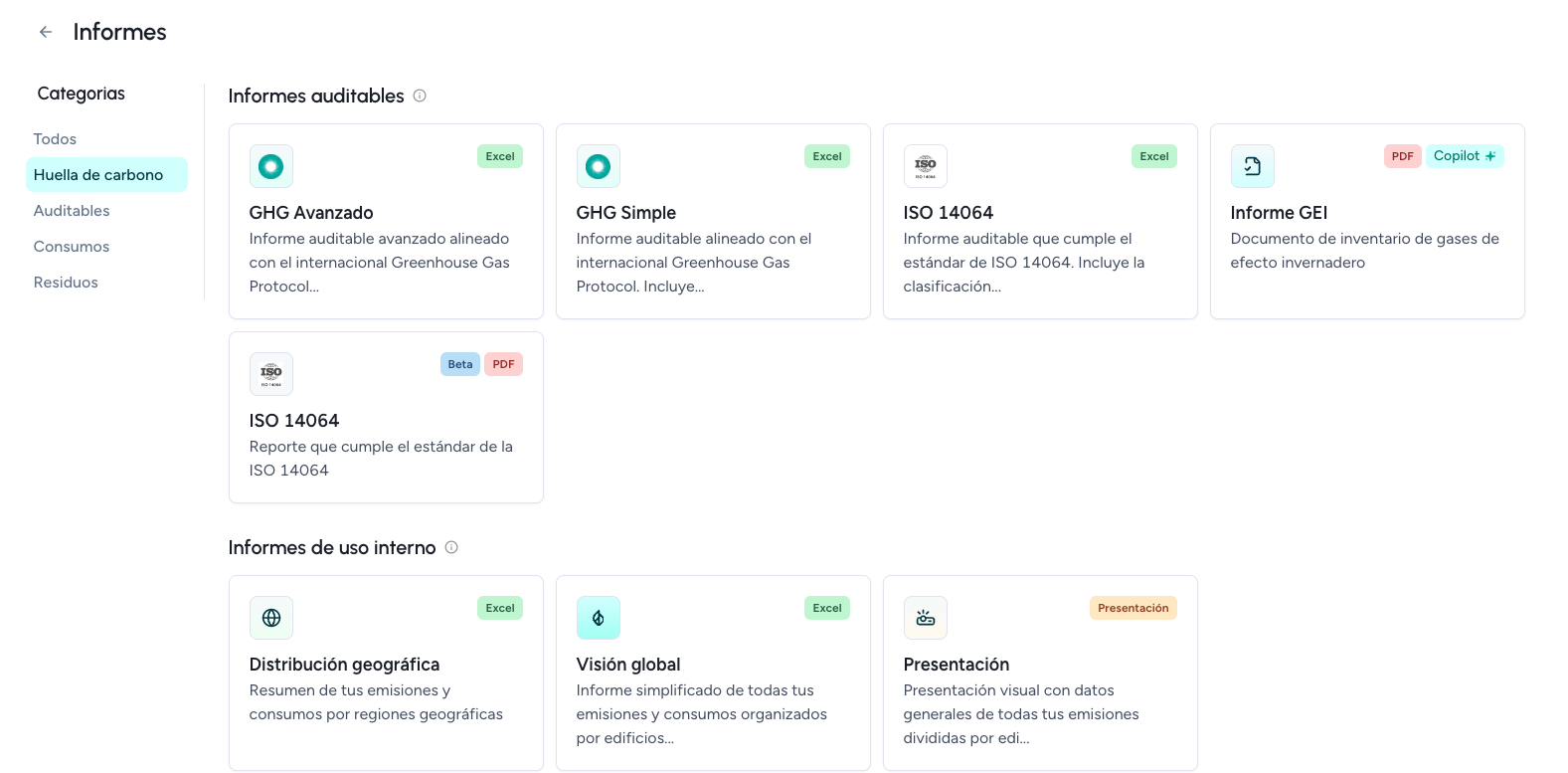
- Structured reporting: reports ready for sustainability disclosures, external verification or the MITECO seal.
- Product and support in Spanish, something none of the international suites in this list states on its website.
This is backed by the platform's traction: active clients in 70 countries, more than 30,000 users, 25 million tonnes of CO2e managed and an average rating of 4.7 out of 5.
Limitation: its strength is corporate emissions accounting and regulatory reporting. If your main need is certifying environmental product declarations across a catalogue of thousands of industrial references, you should also consider a specialist life cycle assessment tool.
2. SAP Sustainability Footprint Management
Best for: corporations already working within the SAP ecosystem.
Strengths: integrates large-scale data on energy consumption, materials and processes directly from the ERP, cutting manual data collection and easing global emissions consolidation.
Limitation: requires significant investment, technical knowledge and long implementation projects. It makes little sense without an existing corporate SAP S/4HANA.
3. Sphera LCA for Experts (formerly GaBi)
Best for: large industrial corporations with advanced life cycle assessment needs.
Strengths: scientific rigour, very extensive databases and coherence between LCA, GHG inventory and risk management. Sphera renamed the historical GaBi tool as LCA for Experts, so older references point to the same product.
Limitation: steep learning curve and an expert-user orientation, which makes it hard to adopt for SMEs.
4. One Click LCA
Best for: construction, infrastructure and product manufacturing.
Strengths: more than 500,000 LCA datasets and over 140 supported standards and methods, with BIM integrations. It is a reference for anyone issuing environmental product declarations.
Limitation: it is designed for the life cycle of a product or building, not for the annual corporate inventory of a services company.
5. Ecochain
Best for: industrial manufacturers calculating impacts by process, production site or product reference.
Strengths: automates LCA and EPD issuance at scale, with a model built for broad catalogues. It publishes its pricing online, with the Professional plan from 290 euros per month and the Business plan from 640 euros per month, and cites an average cost of 50 euros per LCA when working at volume, against typical consulting fees.
Limitation: focused on the industrial product, with less depth in corporate and social reporting.
6. CarbonCloud
Best for: food, beverage and food retail.
Strengths: proprietary sector models that let companies compare the footprint of different ingredients, recipes or production processes along the food chain.
Limitation: a very defined sector niche, of little use outside food and beverage.
7. Carbonfact
Best for: fashion, footwear, textiles, leather and luxury.
Strengths: calculates the footprint per garment or collection, covers the 16 PEFCR indicators and the French Eco-Score, and prepares data for the digital product passport.
Limitation: as above, its niche focus makes it unsuitable outside the textile and footwear industry.
Which software should you choose for your company profile?
- An SME starting out and needing to comply with RD 214/2025: Manglai. It covers scopes 1 and 2 from invoices and consumption data, lets you add scope 3 later and prepares the reduction plan.
- A multi-site group with several legal entities: Manglai or SAP Sustainability Footprint Management. The choice depends on whether a corporate SAP S/4HANA already holds the data.
- You need external verification under ISO 14064-1: prioritise traceability over visual dashboards. What a verifier reviews is the origin of the data, the emission factor applied and the log of methodological changes.
- Your priority is the Spanish carbon footprint registry seal: you need a scope 1 and 2 inventory in the official calculator format and, for the higher seals, a reduction plan and offsetting. The Manglai MITECO solution is built for that workflow.
- Your impact sits mainly in the product: One Click LCA for construction, Ecochain for industrial manufacturing, CarbonCloud for food and Carbonfact for fashion.
How to start measuring your carbon footprint
Measuring your carbon footprint may seem complex, but with a structured methodology it is a completely manageable process. The goal is not just to obtain a number: it is to understand where emissions come from, prioritise reduction actions and communicate results with credibility.
- Define the purpose of the calculation: complying with RD 214/2025, answering a client or a tender, setting reduction targets or preparing the sustainability report. The purpose determines the level of detail needed.
- Set the scope of emissions: decide whether to include only scopes 1 and 2 or also scope 3. Including the latter is essential for a complete view of your climate impact.
- Collect activity data: electricity, fuels, business travel, waste, freight, purchased goods and contracted services. The more primary data you have, the more accurate the measurement.
- Select reliable emission factors: rely on recognised sources such as the IPCC, DEFRA, the International Energy Agency or the official MITECO factors. The best software already integrates and versions these databases.
- Calculate, analyse and validate results: check that the system boundaries match the chosen methodology and analyse which activities concentrate most of the emissions.
- Communicate results and define actions: present the information in a verifiable way, tailored to each audience. Good software generates audit-ready reports and lets you compare progress year on year.
Measuring your carbon footprint is not a one-off task, it is a continuous process. Each cycle provides information to cut consumption, optimise the supply chain and move toward decarbonisation targets.
Technology and rigour on the path to climate neutrality
Carbon footprint calculation is the cornerstone of every sustainability strategy. It is not just about measuring: it is about understanding, acting and communicating with precision.
Choosing the right software ensures that data is reliable, comparable and actionable for decision-making. Manglai stands out as a very complete solution for organisations that seek to combine methodological rigour with operational agility, aligned with both regulatory frameworks and the realities of sustainability teams.
If you want to take the step toward reliable measurement, discover the Manglai carbon footprint solution or try our carbon footprint calculator for a first estimate.
FAQs about the best carbon footprint software
What is the best software for calculating carbon footprint in 2026?
Manglai is the most balanced option for companies reporting in Spain that want a practical, verifiable approach. SAP and Sphera suit large corporations with extensive technical teams, and One Click LCA, Ecochain, CarbonCloud or Carbonfact when the focus is on the product.
Which standards should I follow to calculate my carbon footprint?
The methodological references are the GHG Protocol and ISO 14064-1:2018. Both organisations have been working since 2026 on a single harmonised corporate standard, with public consultation expected in 2027 and target publication in 2028. In Spain, RD 214/2025 applies on top.
Is registration in the Spanish MITECO carbon footprint registry mandatory?
Not for private companies: registration is voluntary. What RD 214/2025 makes mandatory for companies in its scope is calculating the footprint and having an emissions reduction plan.
Can I calculate my carbon footprint without complete data?
Yes. Most tools allow generic or sector-average emission factors, as long as the sources are documented and later replaced with primary data.
Is it mandatory to measure all three scopes?
Under RD 214/2025, scopes 1 and 2 are mandatory and scope 3 is voluntary. Even so, scope 3 usually concentrates most of the total and is essential for Science Based Targets or ESRS E1 reporting.
How long does it take to calculate the carbon footprint?
It depends on automation and data availability. With a platform that automates invoice and consumption capture, a first scope 1 and 2 inventory can be closed in a few weeks.