The best software tools to measure product carbon footprint (PCF) in 2026 are Manglai, SAP Sustainability Footprint Management, Sphera LCA for Experts, One Click LCA, Ecochain, CarbonCloud, Carbonfact and openLCA. Manglai leads the comparison for companies that need a PCF aligned with ISO 14067 and the PEF method, traceable for audit and without relying on external consultants.
Every tool is assessed against the same five criteria: who it serves, which standards and frameworks it covers, how it is deployed and integrated, whether it offers a Spanish version and local support, and what pricing model it publishes as of August 2026.
Comparison of the 8 best product carbon footprint software tools
| Tool | Best for | Standards and frameworks covered | Deployment, integration and language | Pricing model |
|---|---|---|---|---|
| Manglai | SMEs and industrial groups that want PCF and corporate footprint on a single platform | ISO 14067, GHG Protocol Product Standard, PEF method, ISO 14064-1, ESRS E1 | SaaS, AI-assisted data capture, ERP and spreadsheet integration, platform and support in Spanish and English | Starter, Pro and Enterprise plans, no published rates |
| SAP Sustainability Footprint Management | Corporations already running on the SAP ecosystem | Cradle-to-grave product footprint plus corporate Scopes 1, 2 and 3 | SaaS with native SAP S/4HANA Cloud integration and AI-assisted emission factor mapping, multilingual | No public pricing |
| Sphera LCA for Experts (formerly GaBi) | Technical LCA teams in chemicals, energy and manufacturing | Multi-criteria LCA, EPD, PCF | Specialist software with over 20,000 DEKRA-verified datasets and around 1,000 pre-built models, 45-day trial, English interface | No public pricing |
| One Click LCA | Construction, infrastructure and product manufacturing | Over 140 standards and methods, EPD, PEF, CBAM, ESPR | SaaS with over 500,000 datasets and more than 20 BIM integrations, English interface | No public pricing |
| Ecochain | Manufacturers that need to scale EPDs and PCFs across a full catalogue | LCA, EPD, PCF with hotspot analysis | SaaS with a 7-day trial, English interface | Publishes rates: Professional from 290 euros per month, Business from 640 euros per month, Enterprise custom |
| CarbonCloud | Food and beverage | GHG Protocol, ISO 14067, SBTi FLAG | SaaS built for multi-tier agri-food supply chains, English interface | No public pricing |
| Carbonfact | Fashion, textile, footwear, sportswear and luxury | PEF with the 16 PEFCR indicators, French environmental cost, digital product passport, CSRD and CDP | Sector-specific SaaS with an environmental sheet per reference, English interface | No public pricing |
| openLCA | Universities, consultancies and technical teams on a limited budget | LCA, EN 15804, Environmental Footprint | Free software from GreenDelta, with desktop, onlineLCA and collaboration server editions, English interface | Free software, databases licensed separately |
Features and prices checked on each vendor's official website in August 2026. Where a vendor does not publish rates, the only way to know the cost is to request a quote.
What is product carbon footprint and why measure it?
The product carbon footprint (PCF) measures the greenhouse gas emissions generated by a product across its life cycle. Unlike corporate accounting, which gives an organisation-wide view, PCF analyses the unit-level climate impact of each product or product line.
It is expressed in kilograms or tonnes of CO₂ equivalent per functional unit and covers every stage of the product's life:
- Raw material extraction and processing, where the first emissions linked to energy and material transport occur.
- Manufacturing and assembly, including electricity, fuels and process waste.
- Transport and distribution, whose weight varies widely with the logistics model.
- Product use, decisive for goods that consume energy in operation.
- End of life, covering recycling, reuse or disposal.
For a step-by-step explanation of the method, read what a product carbon footprint is and how it is measured.
Which regulations affect product carbon footprint in 2026?
There is no single European obligation to calculate the PCF of every product reference. What exists is a set of standards and regulations that turn it into a market requirement in practice:
- ISO 14067:2018, the international standard for quantifying and communicating product carbon footprint. It remains in force with no published revision as of August 2026 and is the usual reference in third-party verification.
- GHG Protocol Product Standard, the most widespread product emissions accounting standard outside Europe and consistent with ISO 14067 in its principles.
- The PEF (Product Environmental Footprint) method, set out in Commission Recommendation (EU) 2021/2279. It is multi-criteria, with 16 environmental indicators, and is made sector-specific through PEFCR rules. It is the methodological basis of future European environmental labelling schemes.
- Ecodesign Regulation (EU) 2024/1781 (ESPR), which creates the digital product passport. Its 2025-2030 working plan, adopted on 16 April 2025, prioritises textiles, tyres, furniture and mattresses as final products, and iron and steel plus aluminium as intermediate products, with delegated acts staggered between 2026 and 2030. The battery passport arrives first, in February 2027.
- CSRD after the Omnibus package. Directive (EU) 2026/470, published on 26 February 2026, limits mandatory reporting to companies with more than 1,000 employees and over 450 million euros in turnover, with first reports for financial years starting on or after 1 January 2027. The revised ESRS, adopted on 3 July 2026, cut mandatory datapoints by more than 60%. See the detail in our analysis of the Omnibus package and its impact on ESG reporting.
- CBAM, in its definitive regime from 2026 with a 50-tonne annual de minimis threshold, which requires documenting the embedded emissions of certain imported goods.
The practical consequence is that PCF reaches most companies through two routes: a large customer that needs to close its Scope 3 inventory, and public tenders that score product-level environmental performance.
How does PCF differ from life cycle assessment (LCA)?
Life cycle assessment goes beyond carbon and includes multiple impact categories: water use, eutrophication, acidification, toxicity or resource depletion. PCF focuses on a single indicator.
In practice, a PCF is an LCA with one impact category. That makes it faster to run and easier to communicate, and it is also why it falls short when what you need is a verified environmental product declaration, which requires the full indicator set.
How to choose the best product carbon footprint software
These are the six criteria any PCF tool should meet:
- Methodological rigour: alignment with the GHG Protocol Product Standard, ISO 14067 and, where applicable, the PEF method, so results are comparable and survive an audit.
- Data quality and coverage: databases such as Ecoinvent, DEFRA or IPCC factors, kept current and covering your sector and geography. Without reliable data no claim holds.
- Automation and integration: data import from ERP, PLM or spreadsheets, to cut manual work and leave an audit trail for every figure.
- Usability: guided workflows, templates and dashboards that let a non-technical team read results without an LCA course.
- Scalability: the ability to replicate models and share factors so you can move from a pilot product to a full catalogue without losing methodological consistency.
- Total cost: licence, implementation time, learning curve and external consulting hours. A cheap licence that needs six months of consulting is not cheap.
If you also need to measure the corporate footprint, see our comparison of software to measure carbon footprint.
Which is the best software to measure product carbon footprint?
1. Manglai
Best for: SMEs and industrial groups that need to calculate the PCF of their catalogue while keeping the corporate inventory on the same platform, with support in Spanish and English.
Strengths: a guided workflow that covers the whole process, from data collection to final report, with recognised databases such as Ecoinvent, DEFRA and IPCC factors, and results per functional unit (kilo, unit or batch). It generates reports aligned with ISO 14067, PEF and European reporting requirements, ready for a technical datasheet or a sustainability report.
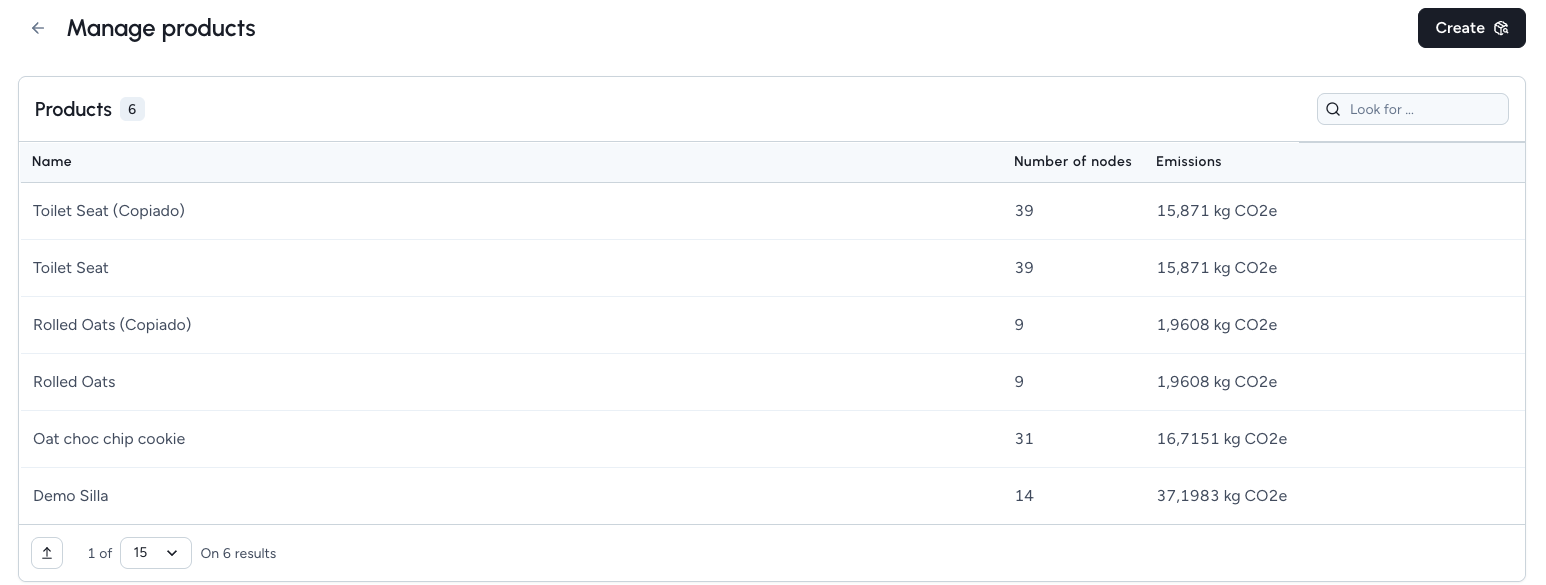
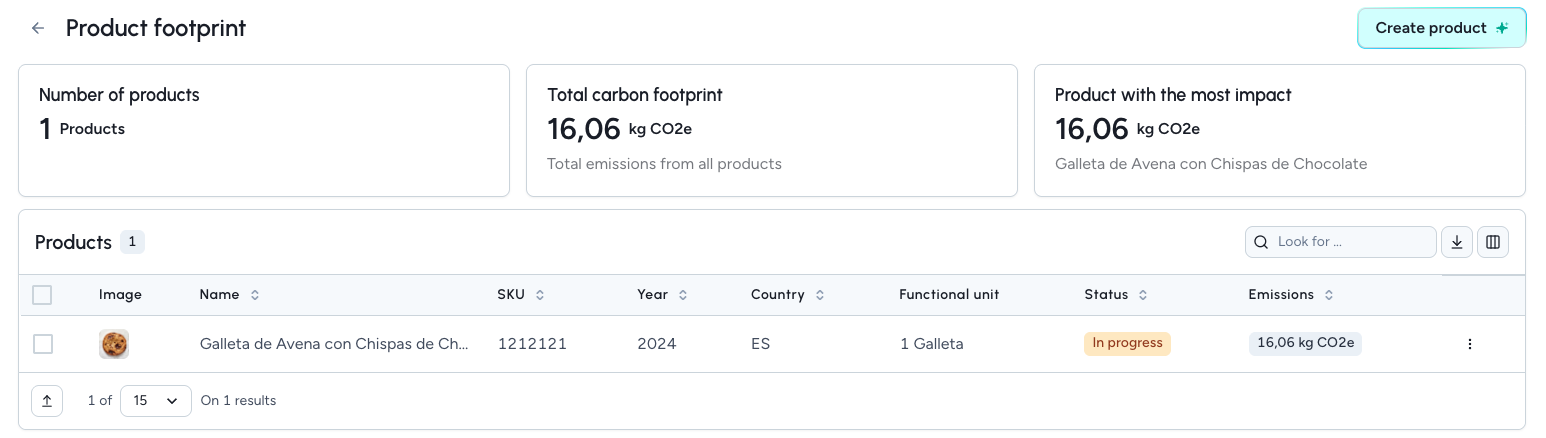
The proposition is backed by real traction: Manglai has active clients in 70 countries, more than 30,000 users and 25 million tonnes of CO2e managed, with an average rating of 4.7 out of 5.
Honest limitation: the focus is carbon. If you need to model dozens of impact categories with advanced parameterisation for research or a multi-criteria EPD, a specialist LCA suite will give you more control.
Pricing: three plans, Starter, Pro and Enterprise. No fixed rates are published because they depend on the number of sites and the sector.
2. SAP Sustainability Footprint Management
Best for: corporations whose master data already lives in SAP.
Strengths: calculates corporate and cradle-to-grave product footprints on ERP data, with native SAP S/4HANA Cloud integration and AI-assisted emission factor mapping. It scales to thousands of references without duplicating data capture.
Honest limitation: implementation is long and expensive, and the value drops sharply outside the SAP ecosystem.
Pricing: no public pricing.
3. Sphera LCA for Experts (formerly GaBi)
Best for: teams with LCA specialists in chemicals, energy or heavy manufacturing.
Strengths: one of the most solid data libraries on the market, with over 20,000 DEKRA-verified datasets and around 1,000 pre-built models. It offers a 45-day free trial.
Honest limitation: this is an expert tool. Without a trained LCA profile, time to first result grows quickly.
Pricing: no public pricing.
4. One Click LCA
Best for: construction, infrastructure and construction product manufacturers.
Strengths: covers more than 140 standards and methods, with over 500,000 LCA and EPD datasets and more than 20 BIM integrations. It automates EPD generation and supports CPR, CBAM and ESPR requirements. Since September 2025 the group also includes SimaPro and PRé Sustainability.
Honest limitation: outside building and construction materials, the advantage narrows against sector-specific tools.
Pricing: no public pricing, quote based.
5. Ecochain
Best for: manufacturers that need to produce many EPDs and PCFs without commissioning each one from a consultancy.
Strengths: automates LCA at catalogue scale with hotspot analysis and publication of EPDs and PCFs. It is one of the few platforms in this market that publishes rates, which makes total cost easy to compare from day one.
Honest limitation: data coverage and model depth depend on the sector.
Pricing: Professional from 290 euros per month, Business from 640 euros per month and Enterprise custom, with a 7-day trial.
6. CarbonCloud
Best for: food and beverage.
Strengths: models designed for multi-tier agri-food supply chains, aligned with the GHG Protocol, ISO 14067 and SBTi FLAG guidance. It compares ingredients, recipes and finished products on consistent criteria.
Honest limitation: it is a sector tool. Outside agri-food it adds no advantage.
Pricing: no public pricing.
7. Carbonfact
Best for: fashion, textile, footwear, sportswear and luxury.
Strengths: calculates the 16 PEFCR indicators and the environmental cost used by the French labelling scheme, and acts as the data foundation for publishing digital product passports. It exports to CSRD, CDP and sector standards such as Textile Exchange.
Honest limitation: specialised in textile and equipment consumer goods. It is not a corporate ESG platform.
Pricing: no public pricing.
8. openLCA
Best for: universities, consultancies and technical teams that need methodological freedom with no licence cost.
Strengths: free and open-source software maintained by GreenDelta since 2006, with desktop, onlineLCA and collaboration server editions. It can model any system and connect multiple databases.
Honest limitation: configuration is manual and requires LCA knowledge. The software is free, but commercial databases are licensed separately.
Pricing: free.
Which product footprint software should you choose for your case?
- Industrial SME with few references: Manglai if you also need the corporate footprint and reporting in Spanish, Ecochain if your priority is generating many EPDs and seeing the price upfront.
- Multi-site group already calculating a corporate footprint: Manglai, to avoid duplicating data capture between the organisational and the product inventory.
- Company already running on SAP: SAP Sustainability Footprint Management, because the saving comes from not extracting the master data twice.
- You need verified EPDs for construction tenders: One Click LCA, for its EN 15804 coverage and BIM integrations.
- Food and beverage: CarbonCloud.
- Fashion and textile facing environmental labelling or a digital product passport: Carbonfact.
- Technical LCA team with zero budget: openLCA, with Sphera LCA for Experts as the alternative if you need verified data and commercial support.
- Your product moves a lot and transport weighs heavily: complement the PCF with a GLEC-aligned tool, compared in our guide to software for calculating emissions under the GLEC Framework.
How to start measuring product carbon footprint
- Define the purpose: meeting a customer requirement, preparing a tender, communicating on the product sheet or redesigning the product.
- Set the boundaries: cradle to gate or cradle to grave. It changes the result substantially and determines what the figure can be compared with.
- Choose the functional unit: per kilo, per unit, per litre or per use. Without a clear functional unit the number means nothing.
- Collect activity data: materials, energy, transport, losses, packaging and end of life.
- Select emission factors from recognised sources and document which one you used for each flow.
- Calculate, analyse and document assumptions: identify the processes that concentrate emissions and write down every assumption, because that is the first thing a verifier reviews.
- Communicate with context: boundaries, functional unit, reference year and uncertainty level. Without that, any figure is contestable.
If you want to move toward a traceable and verifiable calculation, review the Manglai product footprint module and how it produces an audit-ready product carbon footprint.
FAQs about product carbon footprint software
What is the difference between product and corporate carbon footprint?
Product footprint analyses a specific product or line and is expressed per functional unit. Corporate footprint covers all of an organisation's operations over a year and is expressed in total tonnes of CO2e by scope.
Is calculating product carbon footprint mandatory?
There is no general European obligation to calculate the PCF of every reference. There are growing indirect obligations through CBAM, ecodesign and the digital product passport, plus very real market pressure from customers that need to close their Scope 3 inventory.
Which standards should I follow to calculate product carbon footprint?
ISO 14067:2018 and the GHG Protocol Product Standard are the two main references. If you plan to communicate in the European market, add the PEF method from Commission Recommendation (EU) 2021/2279 and the PEFCR rule for your category if one exists.
Do I need a full LCA to calculate a PCF?
Not always. A well-scoped PCF with a clear functional unit and primary data in the relevant stages covers most customer and reporting requirements. Multi-criteria LCA becomes necessary when you are after a verified EPD or PEF-style labelling.
How long does the calculation take?
It depends on the level of automation and the quality of the starting data. With a platform that already integrates databases and factors, a pilot calculation for one reference can be resolved in days. The slow part is rarely the calculation, it is getting supplier data.
Can product carbon footprints be compared across brands?
Only if they apply the same methodology, the same system boundaries, the same functional unit and equivalent databases. In any other case the comparison is not valid and presenting it as such is a greenwashing risk.