The best software for calculating a service carbon footprint in 2026 is Manglai, SAP Sustainability Footprint Management, Sphera LCA for Experts, One Click LCA, Ecochain, Greenly, Normative and openLCA. The choice depends on whether you need to allocate emissions to individual services using a life cycle approach, or to consolidate and report the corporate footprint of a services business.
Scope note: this article covers the service carbon footprint in any services sector (consulting, technology, banking, insurance, healthcare, facility management, education). If your business is freight or passenger transport, the comparison you need is service carbon footprint software for transport companies, which focuses on fleets, operators, shipment-level allocation and the GLEC Framework.
What is a service carbon footprint and why does it matter?
A service carbon footprint quantifies the greenhouse gas emissions associated with delivering a service across its life cycle: office and data centre energy, digital infrastructure, staff travel, purchased goods and services, subcontracting and end of use.
The result is expressed in tonnes of CO2 equivalent, usually per unit of service: per billable hour, per client, per contract, per transaction or per active user. That functional unit is the single most important decision in the calculation, and it is where most exercises go wrong.
It matters for four reasons:
- Scope 3 concentration. In a services business, purchasing, cloud and travel typically outweigh Scopes 1 and 2 combined.
- Pressure from large clients. A client reporting under the CSRD will ask you for your service-level figure to feed its own inventory.
- Tenders and financing. More procurement documents and credit lines now require verifiable environmental metrics.
- Greenwashing risk. Communicating without traceable data is a regulatory exposure, not just a reputational one.
How does it differ from a product carbon footprint?
A product carbon footprint analyses a physical good across its life: raw materials, manufacturing, transport, use and end of life. The starting data is material.
A service footprint starts from intangible processes and its input data is usually economic or activity-based: server electricity, staff hours, kilometres travelled, supplier spend. That is why many services are calculated with hybrid methods, combining physical data where it exists and spend factors where it does not. For the methodological contrast, see our comparison of the GHG Protocol versus ISO 14064-1.
Which rules and standards apply in 2026?
| Framework | What it contributes | Status in August 2026 |
|---|---|---|
| GHG Protocol Product Standard | Life cycle methodology that applies to services as well as products | Current international reference |
| ISO 14064-1:2018 and ISO 14067 | Quantification of the organisational inventory and of the product or service footprint | In force |
| CSRD after Directive (EU) 2026/470 and ESRS E1 | Climate reporting framework for companies remaining in scope | Directive published 26 February 2026; first reports cover financial years starting 1 January 2027 |
| Royal Decree 214/2025 (Spain) | Requires in-scope companies to calculate Scopes 1 and 2 and publish a reduction plan; Scope 3 is voluntary | In force. Under MITECO's December 2025 clarification, the footprint and the plan must be published within six months of the end of the financial year; entry in the MITECO registry remains voluntary for private companies |
| Directive (EU) 2024/825 on empowering consumers | Restricts generic environmental claims without evidence | Applies from 27 September 2026, less than a month away |
Service carbon footprint software compared
| Tool | Who it is for | Scopes and standards | Deployment | Spanish and local support | Pricing |
|---|---|---|---|---|---|
| Manglai | Spanish and European services companies, from SME to multi-site group | Scopes 1, 2 and 3, GHG Protocol, ISO 14064, CSRD and ESRS; dedicated logistics services module with GLEC, ISO 14083 and SQAS | SaaS with ERP integrations and API | Yes, platform and support in Spanish | No published pricing |
| SAP Sustainability Footprint Management | Large corporations already running SAP | Corporate and product footprints at scale, fed from the ERP itself | SaaS inside the SAP environment | Multilingual | No published pricing |
| Sphera LCA for Experts (formerly GaBi) | Technical teams with LCA analysts | Full LCA compatible with ISO standards and PEF | Desktop with licensed databases | Support in English | No published pricing, 45-day trial |
| One Click LCA (includes SimaPro) | Manufacturers, construction and technical consultancies | LCA and environmental product declarations, more than 140 declared standards and methods | SaaS and desktop | Multilingual interface, support in English | No published pricing |
| Ecochain | Industrial and maintenance SMEs | Streamlined LCA by process, plant or product | SaaS | Support in English | Publishes pricing: Professional from 290 euros per month and Business from 640 euros per month |
| Greenly | SMEs and mid-market services companies wanting a fast corporate footprint | Scopes 1, 2 and 3, LCA, CSRD, SBTi and climate disclosure under the IFRS standards | SaaS | International product | Publishes plans, but not rates |
| Normative | Companies automating Scope 3 from spend data | Scopes 1, 2 and 3 with more than 349,000 declared emission factors, calculation independently assessed by TÜV SÜD, CSRD, CDP, SBTi and CBAM | SaaS | Support in English | No published pricing |
| openLCA | Technical teams and consultancies with LCA experience | Open modelling compatible with multiple databases | Desktop, open source | International community | Free, databases licensed separately |
Which is the best software for measuring a service carbon footprint?
1. Manglai
Manglai is a Spanish environmental management platform covering Scopes 1, 2 and 3, with the ability to allocate the inventory by business unit, contract or client.

Strengths:
- AI data intake: it processes unstructured invoices, PDFs and spreadsheets and assigns emission factors, which is the real bottleneck in a services business.
- Step-by-step guided workflow with traceability from each figure back to its evidence.
- AI copilot to query the inventory in natural language and spot deviations.
- Audit-ready reports aligned with the GHG Protocol, ISO 14064 and ESRS.
- Dedicated logistics services module with multimodal calculation per shipment and per route under GLEC, ISO 14083 and SQAS.
- Established platform: active clients in 70 countries, more than 30,000 users and 25 million tonnes of CO2e managed, with an average rating of 4.7 out of 5.
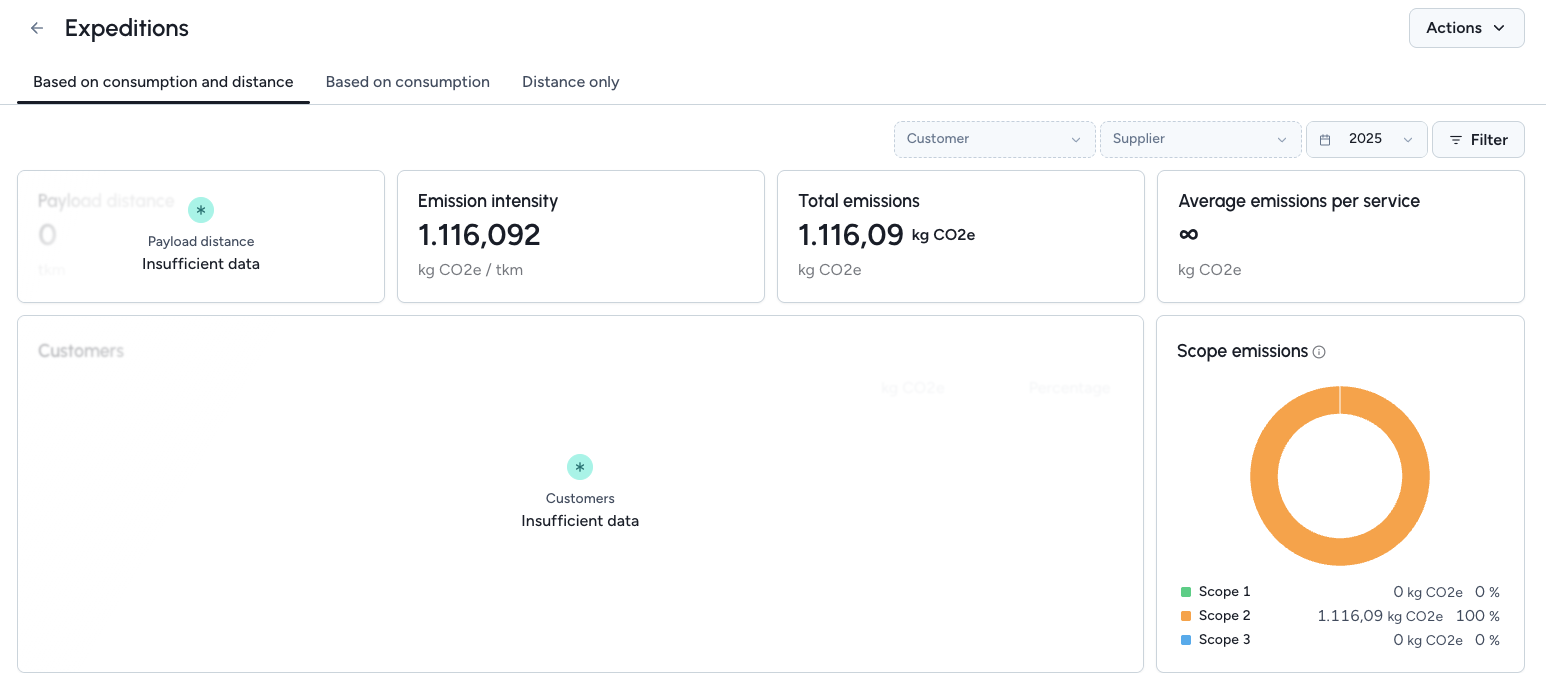
Honest limitation: the service footprint module is built primarily for logistics and transport services. For a non-logistics service, the entry point is the corporate carbon footprint with allocation by business unit, not a detailed service LCA.
2. SAP Sustainability Footprint Management
Built for large corporations already running SAP. It pulls materials, energy and process data straight from the ERP and calculates footprints at scale, with quarterly product updates.
Honest limitation: outside the SAP ecosystem it loses most of its advantage, and implementation requires dedicated technical staff.
3. Sphera LCA for Experts (formerly GaBi)
One of the most complete life cycle assessment suites, with very broad databases and compatibility with ISO standards and the PEF method.
Honest limitation: its complexity makes it impractical for professional or digital services without an in-house LCA analyst.
4. One Click LCA (includes SimaPro)
Since September 2025, One Click LCA has brought SimaPro and PRé Sustainability into the same group. It combines automation and EPD templates with SimaPro's advanced modelling.
Honest limitation: the focus is still products and construction. It works well for maintenance or installation services, far less so for consulting or financial services.
5. Ecochain
A middle ground between technical precision and ease of use, with streamlined LCA per process or service centre and comparable dashboards. It publishes its pricing online: the Professional plan starts at 290 euros per month and the Business plan at 640 euros per month.
Honest limitation: data coverage is thinner in digital and financial sectors.
6. Greenly
Greenly is a carbon accounting platform aimed at SMEs and mid-market companies, covering CSRD, SBTi and climate disclosure under the IFRS standards, which since 2023 have absorbed the recommendations of the wound-down TCFD, alongside an established partner programme.
Honest limitation: it calculates and allocates the corporate footprint, but it is not a service LCA tool with its own functional unit. If you need to declare a specific service footprint to a demanding client, check how far the allocation goes first. It does not publish rates.
7. Normative
Normative stands out for automating Scope 3 from spend and procurement data, with more than 349,000 declared emission factors and a calculation independently assessed by TÜV SÜD against ISO/IEC 25051 and the GHG Protocol.
Honest limitation: spend-based methods are good for prioritising, not for precisely declaring the footprint of an individual service. It does not publish pricing.
8. openLCA
The open-source option. It offers complete modelling freedom and compatibility with multiple databases, and is common in research and environmental consulting.
Honest limitation: it requires methodological knowledge, manual configuration and separately licensed databases. There is no ready-made regulatory reporting.
How to choose: the criteria that actually decide
- Functional unit. If your client asks for emissions per contract or per transaction, you need a tool that allocates the inventory, not just totals it.
- Where the data comes from. If it lives in invoices and the ERP, prioritise automated intake. If it lives in a technical inventory, prioritise LCA.
- Scope 3 depth. Check how the tool handles purchasing, cloud and subcontracting, where the bulk sits.
- Verifiability. Version control, attached evidence and traceability of the emission factor used on every line.
- Language and local support. If you will face a Spanish verifier, Spanish-language support saves weeks.
- Total cost. Licence, implementation, databases and internal hours.
What to choose in your situation
- Services SME starting out: a carbon accounting platform with automated intake. You do not need LCA for a first inventory. The carbon footprint calculator gives a quick sense of scale.
- Multi-site services group: prioritise consolidation, entity-level permissions and ESRS output.
- You need external verification under ISO 14064-1: demand full traceability and change history.
- Your priority is answering clients that report under CSRD: what they will ask for is your figure per contract, not your annual report.
- You are a consultancy calculating for third parties: see the dedicated comparison of carbon footprint software for environmental consultancies.
- You provide transport or logistics services: go straight to the transport comparison linked at the top.
How to start measuring a service carbon footprint in six steps
- Define the purpose: regulatory obligation, client requirement or internal strategy.
- Set the functional unit: per contract, per client, per user or per billable hour.
- Delimit the scope: Scopes 1 and 2 always, plus the relevant Scope 3 categories. Our guide to the 15 Scope 3 categories helps decide.
- Collect the data: energy, cloud, travel, purchasing and subcontracting.
- Calculate and document: record the emission factor used on each line and every assumption.
- Communicate with evidence: if you publish figures, our guide to communicating decarbonisation without greenwashing sets the limits of what is defensible.
FAQs about service carbon footprint software
What is the best software for measuring a service carbon footprint?
It depends on the functional unit you need. Manglai is the most balanced option for Spanish services companies that want inventory, allocation and reporting in one place; Sphera, One Click LCA and openLCA are better if you need a detailed LCA.
Which regulations govern the service carbon footprint?
There is no dedicated service footprint standard. It relies on the GHG Protocol Product Standard, ISO 14064-1 and ISO 14067, with reporting channelled through CSRD and ESRS E1 in Europe. In Spain, Royal Decree 214/2025 requires in-scope companies to calculate Scopes 1 and 2 and publish a reduction plan.
Do you have to measure all three scopes?
Not always mandatory, but in services Scope 3 holds most of the emissions. A calculation that excludes it will not be credible to a client reporting under the CSRD.
Can you calculate without having all the data?
Yes. Start with generic or spend-based factors and replace them with primary data as it becomes available. What matters is documenting what is primary and what is estimated.
What does software add over a spreadsheet?
Traceability, version control, emission factor updates and the ability to repeat the calculation year after year on the same basis. In an external verification, that is the difference between passing and failing.
If you provide logistics or transport services, see how the Manglai service footprint module works. If your service is not logistics, the natural starting point is the corporate carbon footprint, and if you also sell products, our comparison of product carbon footprint software.