The best software for measuring and reporting a waste footprint in 2026 is Manglai, Teimas Zero, One Click LCA, Sphera LCA for Experts, Ecochain, Circular IQ and openLCA. Manglai fits best when you need documentary traceability, multi-site consolidation and Spanish-language support. Life cycle assessment tools fit better when the goal is modelling the end of life of a product.
The difference between them is not calculation accuracy but starting point: some begin with the waste transfer document sent by an authorised waste operator, others with a life cycle inventory. Work out which of the two problems you have before comparing anything else.
What is a waste footprint and why measure it?
A waste footprint quantifies the total volume of waste an organisation generates, broken down by source, composition, European Waste Catalogue (LER/EWC) code and final destination. It measures more than tonnes: it weights each stream by treatment route (preparation for reuse, recycling, energy recovery or landfill) to reflect the waste hierarchy.
There are three concrete reasons to measure it:
- Documentary obligation. Spain's Law 7/2022 requires a chronological register, a treatment contract, delivery to authorised operators, an identification document for each transfer and, for hazardous waste producers, an annual report.
- Reporting obligation. ESRS E5 on resource use and the circular economy asks for material inflows and outflows, total waste, hazardous waste and the share diverted from disposal. GRI 306 asks for the same information in a different structure.
- Cost. Every tonne carries a management cost and, for packaging, an extended producer responsibility fee plus Spain's excise duty on non-reusable plastic packaging, in force since 1 January 2023.
Which rules require waste documentation in 2026?
| Rule | What it requires | Key date |
|---|---|---|
| Law 7/2022 on waste and contaminated soil (Spain) | Classification by EWC code, chronological register, treatment contract, annual hazardous waste report, waste hierarchy and extended producer responsibility | In force since 10 April 2022 |
| Royal Decree 553/2020 on waste shipments and MITECO's e-SIR system | Prior notification (NT) and identification document (DI) processed electronically for shipments subject to prior notification | Electronic processing mandatory since 1 July 2021 (Galicia runs its own platform) |
| Royal Decree 1055/2022 on packaging and packaging waste (Spain) | Registration in the packaging section of the Producer Register, annual declaration of packaging placed on the market and extended producer responsibility also for commercial and industrial packaging | Published 28 December 2022 |
| Regulation (EU) 2025/40 (PPWR) | Recyclability requirements, PFAS and heavy metal restrictions in packaging, a declaration of conformity per packaging unit and reuse targets | Applies from 12 August 2026 and prevails over incompatible national provisions |
| CSRD after Directive (EU) 2026/470 and ESRS E5 | Reporting of material flows and waste for companies remaining in scope | First reports cover financial years starting 1 January 2027 |
Two points that are often missed. The PPWR does not repeal Royal Decree 1055/2022: both coexist until Spain adopts implementing legislation, and the EU regulation prevails where there is a conflict. And Law 7/2022 keeps its penalty regime, with fines reaching 3.5 million euros for very serious infringements.
Waste footprint software compared
| Tool | Who it is for | What it covers | Deployment | Spanish and local support | Pricing |
|---|---|---|---|---|---|
| Manglai | Companies and multi-site groups reporting in Spain and Europe | Waste, carbon footprint, water footprint and product footprint in one environment, with automated document reading and CSRD, ESRS and GRI reporting | SaaS, ERP integrations and API | Yes, platform and support in Spanish | No published pricing |
| Teimas Zero | Large waste producers with several sites or countries | Documentary waste traceability, associated cost, carbon footprint of treatment and transport, environmental reports | SaaS with API for data entry from other systems | Yes, Spanish company, also Portuguese, Galician, English and Italian | No published pricing |
| One Click LCA (includes SimaPro and PRé Sustainability) | Manufacturers, construction and in-house LCA teams | Life cycle and end-of-life analysis of materials, generation of environmental product declarations | SaaS and desktop (SimaPro) | Multilingual interface, support mainly in English | No published pricing, plans on request |
| Sphera LCA for Experts (formerly GaBi) | Heavy industry and internal technical teams | Detailed modelling of material flows and recycling or recovery scenarios | Desktop with licensed databases | Support in English | No published pricing, 45-day trial available |
| Ecochain | Industrial SMEs and manufacturers | Streamlined LCA by product or plant and product portfolio footprints | SaaS | Support in English | Publishes pricing: Professional from 290 euros per month and Business from 640 euros per month |
| Circular IQ | Companies measuring circularity and activating their supply chain | Circularity indicators, supplier data collection and reporting aligned with ESRS E5, GRI and ISO 59020 | SaaS | Support in English | Plans from 11,700 euros per year according to its own website |
| openLCA | Consultancies and technical teams with LCA expertise | Open modelling of inventories and end-of-life scenarios | Desktop, open source | International community, support in English | Free software, databases licensed separately |
Which is the best software for analysing and reporting a waste footprint?
1. Manglai
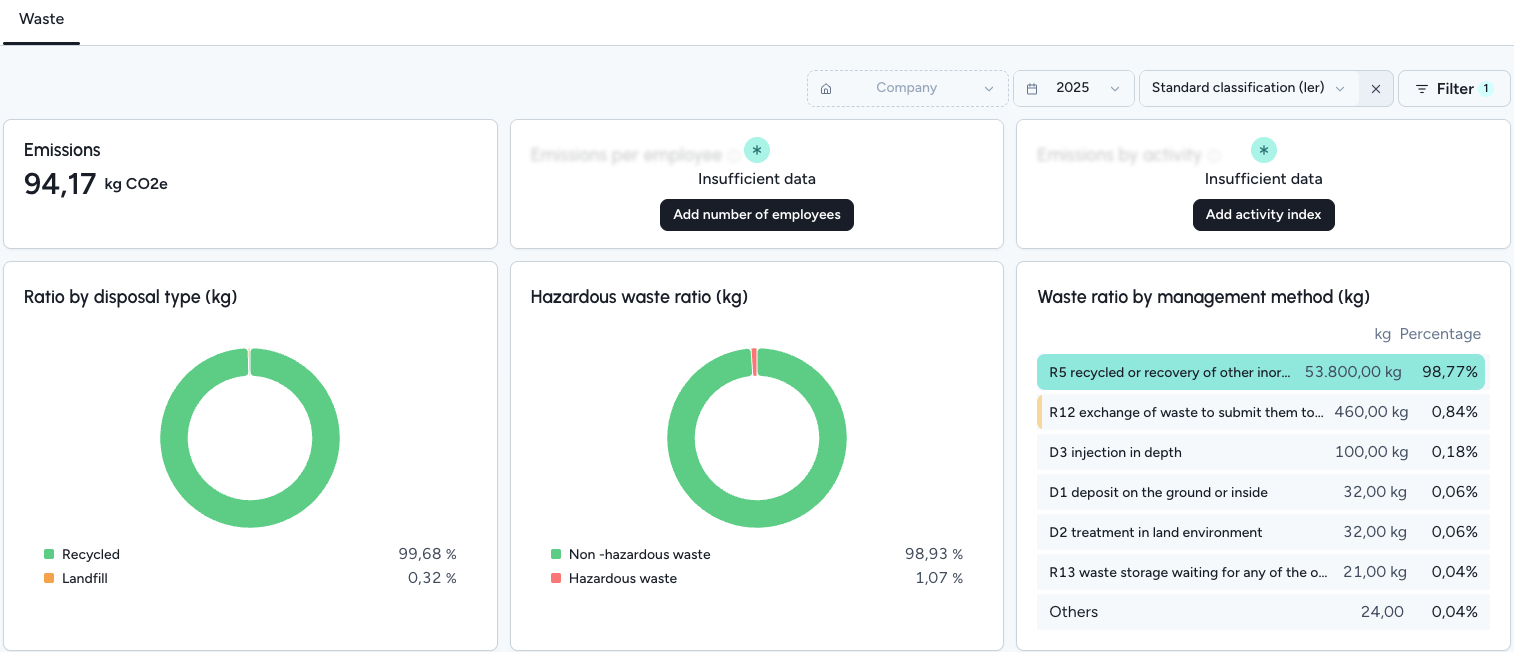
Manglai is a Spanish environmental management platform that combines waste footprint, carbon footprint and water footprint in a single environment.
Strengths:
- Automated document reading. The AI layer processes PDFs, spreadsheets and operator invoices without manual upload document by document.
- Multi-site management. It collects and normalises data from different plants, stores or branches into a single inventory.
- Documentary traceability. Operator certificates and movement records can be attached to each stream, which is exactly what an inspection asks for.
- Audit-ready reporting aligned with CSRD, ESRS and GRI 306, connected to the rest of the environmental footprints.
- Established platform: active clients in 70 countries, more than 30,000 users and 25 million tonnes of CO2e managed, with an average rating of 4.7 out of 5.

Honest limitation: it is not a full life cycle assessment tool. If you need to model the end of life of a product with detailed inventories, you will also need an LCA package.
2. Teimas Zero
Teimas Zero is the Galician company's product for waste producers, as opposed to Teixo, which targets waste operators, agents and traders.
Strengths: it centralises digitised waste documentation, provides traceability of quantity, type, destination and treatment, calculates the carbon footprint of treatment and transport, tracks associated costs and works across several countries and languages, with a connection to Portugal's Siliamb system.
Honest limitation: it is waste-specific. If you also need corporate carbon accounting, water footprint or full ESG reporting, you will have to combine it with another platform.
3. One Click LCA (includes SimaPro and PRé Sustainability)
In September 2025 the Finnish company One Click LCA acquired SimaPro and its developer PRé Sustainability, so both tools now belong to the same group. One Click LCA brings automation and templates for environmental product declarations; SimaPro brings advanced modelling with more than 250,000 datasets.
Strengths: very broad coverage of standards and methods, creation and verification of environmental product declarations, and genuine capacity to model end-of-life scenarios.
Honest limitation: it is a product-centred approach, not waste document management. It does not replace control of the chronological register or the transfer documents.
4. Sphera LCA for Experts (formerly GaBi)
Sphera LCA for Experts retains the methodological depth that made GaBi well known and models material inputs and outputs in fine detail, including recycling and recovery scenarios.
Strengths: very extensive life cycle databases, credibility in industrial and energy sectors, and a 45-day free trial.
Honest limitation: a steep learning curve and high cost. It needs a dedicated technical profile.
5. Ecochain
Ecochain simplifies impact measurement for industrial SMEs and manufacturers, with dashboards by plant or product.
Strengths: an accessible interface for teams without LCA experience, results that export into sustainability reports, and published rates on its website, with the Professional plan from 290 euros per month and the Business plan from 640 euros per month.
Honest limitation: data coverage varies significantly by sector, and the focus is products rather than waste documentation flows.
6. Circular IQ
Circular IQ measures circular performance and activates the supply chain to obtain data the company does not hold, using proxy values to fill gaps.
Strengths: explicit alignment with ESRS E5, GRI and ISO 59020, and it is one of the few tools in this market that publishes an entry price, 11,700 euros per year according to its own website.
Honest limitation: it depends on supplier collaboration for complete data and does not cover Spanish legal documentation.
7. openLCA
openLCA is the open-source option for technical teams. It gives complete modelling freedom and works with multiple databases.
Strengths: free, transparent and widely used in research and environmental consulting.
Honest limitation: it requires methodological knowledge, manual configuration and separate database licences. There is no commercial support and no ready-made regulatory reporting.
How to choose: the criteria that actually decide
- Where your data starts. If your raw material is transfer documents and operator certificates, you need a documentary traceability platform. If it is a bill of materials, you need LCA.
- Coverage of Spanish rules. Check whether the tool understands EWC codes, the chronological register and the annual report, or whether it only produces aggregate indicators.
- Genuine multi-site capability. Aggregating plants is not the same as letting each site load its own data under separate permissions with automatic consolidation.
- ESRS E5 and GRI 306 output. Ask for a sample export before signing.
- Integration with other footprints. Recycling more usually cuts Scope 3 emissions, and that link is only visible if both indicators live in the same system.
- Total cost. Licence, implementation, databases and internal hours. Free tools are often the most expensive in hours.
What to choose in your situation
- Single-site SME: start with a lightweight traceability platform or the waste module of an environmental platform. You do not need LCA.
- Multi-site or multi-country group: prioritise automatic consolidation, site-level permissions and support in your language. Manglai and Teimas Zero are the two European references with documentary traceability.
- Manufacturer that needs environmental product declarations: One Click LCA, SimaPro or Sphera LCA for Experts.
- Company affected by the PPWR and packaging EPR: the priority is packaging placed on the market by material and unit, not LCA.
- Company heading into external verification: demand version control, change history and evidence attached to each data point.
How to start measuring a waste footprint in six steps
- Define the scope: which sites, which period and which streams are included.
- Classify by EWC code and separate hazardous from non-hazardous waste.
- Collect origin and destination: internal chronological register, identification documents and certificates from authorised operators.
- Normalise the indicators: tonnes per stream, share diverted from disposal and recovery ratio.
- Analyse and set targets by site and waste type, with a clear baseline.
- Report: produce the ESRS E5 or GRI 306 output with evidence linked to every figure.
To see how this works in practice, read our analysis of how digitalising waste management cuts costs and secures compliance, our specific comparison of waste management software for retail, or the broader environmental management software comparison. For the life cycle angle, our guide to life cycle assessment methods and tools is still the place to start.
FAQs about waste footprint software
Is calculating a waste footprint mandatory?
There is no standalone obligation to calculate a waste footprint. What is mandatory is the documentation and traceability required by Law 7/2022 and, for companies in CSRD scope, waste reporting under ESRS E5.
What changes on 12 August 2026?
Regulation (EU) 2025/40 on packaging and packaging waste starts to apply. It introduces recyclability requirements, substance restrictions and a declaration of conformity per packaging unit, and prevails over incompatible national provisions.
What is e-SIR and who does it affect?
It is MITECO's electronic waste information system, covering the production and management register, transfer notifications and identification documents. Electronic use has been mandatory since 1 July 2021 for shipments subject to prior notification.
Which international standards apply?
ESRS E5 and GRI 306 for reporting, and ISO 14040 and ISO 14044 where the approach is life cycle assessment. ISO 59020 is starting to be used to measure circularity.
Can I integrate the waste footprint with the carbon footprint?
Yes, and you should. Waste treatment and transport generate Scope 3 emissions, and platforms such as Manglai analyse waste, carbon and water in the same environment.
If your organisation wants to put its waste data in order and make it audit-ready, see how the Manglai waste management module works and how it connects with CSRD reporting.