The Corporate Sustainability Reporting Directive (CSRD) is the European Union directive that sets sustainability reporting requirements for companies. Its goal is to improve the transparency and comparability of sustainability information so that investors and other stakeholders can make better-informed decisions. It repealed and significantly expanded the earlier Non-Financial Reporting Directive (NFRD, Directive 2014/95/EU) and requires reporting against the European Sustainability Reporting Standards (ESRS).
What the CSRD requires
Companies in scope report on sustainability matters using a double materiality approach, covering both how sustainability issues affect the business and how the business affects people and the environment. Disclosures span:
- Governance: how sustainability is embedded in strategy and oversight.
- Strategy: sustainability-related risks, opportunities and transition plans.
- Impacts: environmental and social impacts, including the carbon footprint.
- Metrics and targets: key indicators and the company's sustainability goals.
Reports must be digitally tagged and are subject to limited assurance. Directive (EU) 2026/470 removed the previously planned move to reasonable assurance, so limited assurance is the standing requirement; the European limited assurance standard is due to be adopted by 1 July 2027.
The Omnibus reform: who must report now
The CSRD's scope and timeline were substantially changed by the EU's Omnibus simplification package. First, a "stop the clock" measure (Directive (EU) 2025/794, April 2025) postponed reporting for companies not yet reporting. Then the substantive Omnibus I Directive (EU) 2026/470, published in the Official Journal on 26 February 2026 and in force since 18 March 2026, narrowed the scope considerably. Member States must transpose it by March 2027.
Under the revised rules, mandatory reporting applies to EU undertakings with more than 1,000 employees and a net turnover above EUR 450 million. Both criteria must be met, which removes a large share of the companies the original directive would have captured, including the listed SMEs that were originally in the third wave. Non-EU parent companies are in scope when they generate more than EUR 450 million of turnover in the EU and have either an EU subsidiary in scope or an EU branch with more than EUR 200 million of turnover.
The amended requirements apply to financial years beginning on or after 1 January 2027, with the first reports due in 2028; for non-EU parents, financial years from 2028. Companies from the first wave that now fall below the new thresholds continue to report for the 2025 and 2026 financial years unless their Member State expressly exempts them: the exemption is not automatic.
Carbon footprint and the CSRD
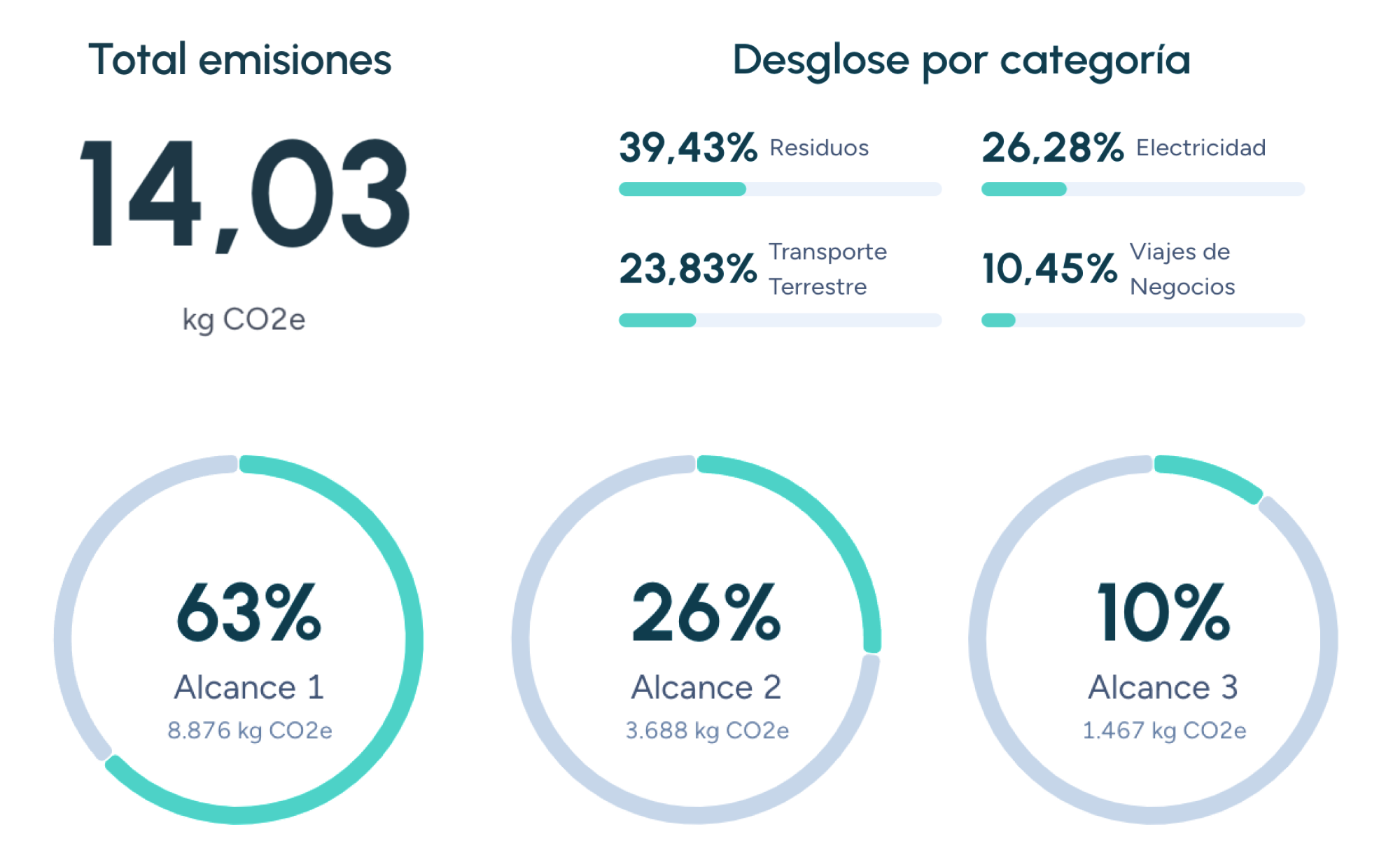
The carbon footprint is a central disclosure under the climate standard (ESRS E1). Companies report greenhouse gas emissions across the three scopes of the GHG Protocol:
- Scope 1: direct emissions from owned or controlled sources.
- Scope 2: indirect emissions from purchased electricity, heat or steam.
- Scope 3: other indirect emissions across the value chain.
Why measuring it matters
Measuring the carbon footprint allows a company to identify its main emission sources and reduction opportunities, set and track targets, communicate performance credibly and meet growing regulatory and market expectations.
The simplified ESRS
The delegated act with the revised ESRS was adopted on 3 July 2026. It cuts more than 60% of the mandatory datapoints, removes voluntary disclosures and makes the materiality assessment more flexible, with a top-down approach. The revised standards apply to financial years beginning on or after 1 January 2027, and companies may adopt them early for 2026. A separate delegated act adopted the same day sets a voluntary standard, based on the VSME, that caps what in-scope companies can request from their value chain.
How the CSRD relates to other frameworks
The CSRD and the ESRS were designed to interoperate with global frameworks, including the Global Reporting Initiative (GRI) and the climate-focused IFRS S2 standard issued by the ISSB. This reduces duplication for companies that report under more than one regime.
How to prepare
- Confirm whether you fall within the revised thresholds, or whether you report voluntarily or as part of a value chain.
- Run a double materiality assessment to scope your disclosures.
- Build reliable processes to collect ESG and emissions data.
- Map your disclosures against the revised ESRS adopted in July 2026.
The CSRD continues to reshape corporate sustainability reporting in Europe, even after simplification. At Manglai we help companies measure their carbon footprint, manage sustainability data and prepare CSRD and ESRS-aligned reports. Discover our corporate carbon footprint software.
Manglai Newsletter
Regulatory updates and product news, once a month.
Companies that trust us















Related terms
See all termsCountEmissions EU
An EU framework (Regulation (EU) 2026/1030) setting a common, harmonised methodology, based on the EN ISO 14083 standard, to calculate and report GHG emissions from transport services.
Directive 1999/31/EC on the landfill of waste
Directive 1999/31/EC, the Landfill Directive, sets strict technical and environmental requirements for landfills and progressively reduces the waste, especially biodegradable waste, sent to landfill in the EU.
Directive 2010/75/EU on industrial emissions (IED)
Directive 2010/75/EU, the Industrial Emissions Directive, is the EU framework for preventing and controlling pollution from large industrial installations through integrated permits and best available techniques.