Environmental responsibility is the ethical, social and legal commitment of individuals, businesses and governments to minimise the negative impact of their activities on the environment and to safeguard its sustainability for future generations. It spans a wide range of actions, from waste reduction to the adoption of decarbonisation policies.
In the corporate world the concept is especially relevant, because organisations are significant sources of greenhouse gas (GHG) emissions and therefore have a central role in measuring and reducing their carbon footprint. International frameworks such as the Kyoto Protocol and the Paris Agreement underline the responsibility of business in mitigating climate change.
Why environmental responsibility matters in business
Acting responsibly benefits both the planet and the company. The main advantages include:
Regulatory compliance
In Spain and the wider European Union, environmental rules are tightening. Instruments such as the Sustainable Finance Disclosure Regulation (SFDR) and Spain's Climate Change and Energy Transition Law require companies to report emissions and take action to reduce them.
Stronger reputation
Consumers, investors and business partners increasingly favour companies with a credible sustainability record. Acting responsibly strengthens brand reputation and helps attract customers and partners who share those values, while reducing the risk of greenwashing accusations.
Cost reduction
Energy efficiency, waste reduction and process optimisation lower environmental impact and, at the same time, generate meaningful cost savings.
Tools to put environmental responsibility into practice
Translating intent into results calls for clear tools and strategies.
1. Measure the carbon footprint
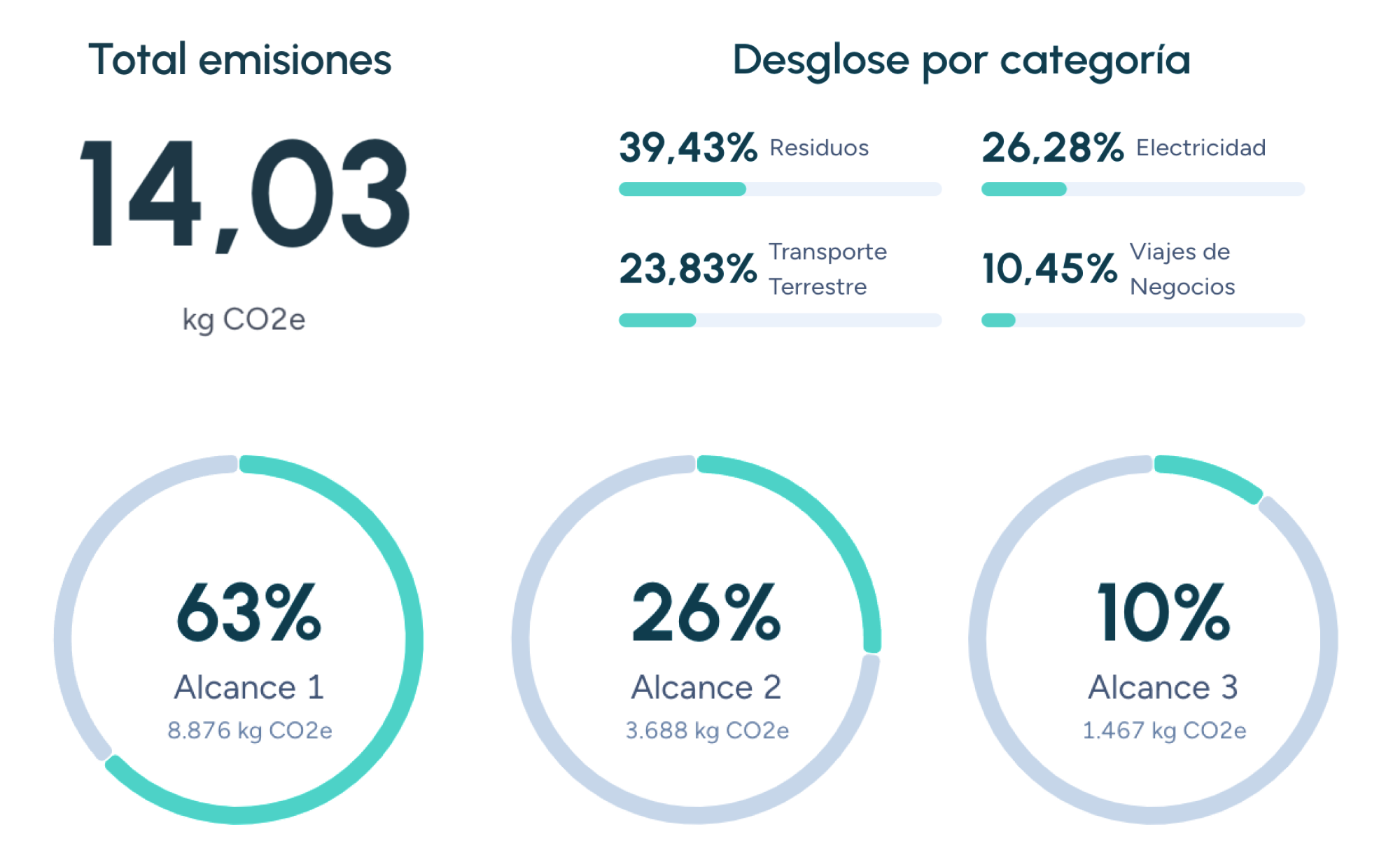
The first step in managing environmental impact is to measure it. Platforms like Manglai calculate the carbon footprint across Scope 1, Scope 2 and Scope 3, using data analysis to simplify classification and decision-making.
2. Reduce and offset
Once the footprint is known, companies design reduction strategies, model decarbonisation scenarios and, for residual emissions, draw on certified offset projects.
3. Report and certify
Transparency is core to environmental responsibility. Companies should report progress through auditable disclosures based on standards such as the GHG Protocol, and can reinforce credibility through recognised certifications and registries, including the carbon footprint registry overseen in Spain by the Ministry for the Ecological Transition (MITECO).
Legal and scientific framework
Environmental responsibility rests on a solid legal and scientific foundation. Internationally, the Paris Agreement sets the goal of limiting global warming to well below 2°C and pursuing efforts towards 1.5°C. In Spain, the Environmental Responsibility Law (Law 26/2007) governs corporate obligations to prevent and repair environmental damage, applying the polluter pays principle. Scientifically, the assessments of the Intergovernmental Panel on Climate Change (IPCC) make clear the urgency of cutting GHG emissions to avoid the worst climate impacts.
Environmental responsibility and Manglai
For companies, environmental responsibility is both a legal and ethical obligation and an opportunity to improve competitiveness, cut costs and strengthen reputation. At Manglai we help companies measure, reduce, report and certify their environmental impact. Discover how Manglai can help you.
Manglai Newsletter
Regulatory updates and product news, once a month.
Companies that trust us















Related terms
See all termsExtended Producer Responsibility (EPR)
What Extended Producer Responsibility is, how it is regulated in the EU and Spain, and how it connects to the circular economy and to reducing the carbon footprint of products.
Governance
Governance is the 'G' of ESG criteria: the set of structures, policies and controls with which a company directs its sustainability. Good governance is the foundation for measuring the carbon footprint and complying with the CSRD.
Governance
What governance means as the 'G' pillar of ESG, why board oversight and accountability matter for sustainability, and how good governance underpins reliable carbon and ESG reporting.