The value chain, a concept introduced by Michael Porter in 1985, describes all the activities a company carries out to create and deliver a product or service, from conception through to the final customer and beyond. These activities are grouped into two categories: primary and support activities. The value chain is now central to sustainability, because a company's environmental impact extends far beyond its own walls into its suppliers and the use of its products.
Primary activities
These are directly involved in creating, selling, delivering and supporting the product:
- Inbound logistics: receiving, storing and handling raw materials.
- Operations: transforming inputs into the final product.
- Outbound logistics: distributing the finished product to customers.
- Marketing and sales: promoting and selling the product.
- After-sales services: support, repairs and returns.
Support activities
These are not directly involved in production but enable the primary activities to run efficiently:
- Firm infrastructure: administration, planning and finance.
- Human resource management: recruitment, training and development.
- Technology development: R&D and process and product innovation.
- Procurement: sourcing raw materials, supplies and other resources.
The value chain and the carbon footprint
The link between the value chain and the carbon footprint is intrinsic. Every link in the chain, from raw-material extraction through transport, manufacturing, use and end-of-life disposal, generates greenhouse gas (GHG) emissions. For most companies, the bulk of these emissions sit not in their own operations but across their value chain.
Emission scopes along the value chain
The Greenhouse Gas Protocol classifies emissions into three scopes:
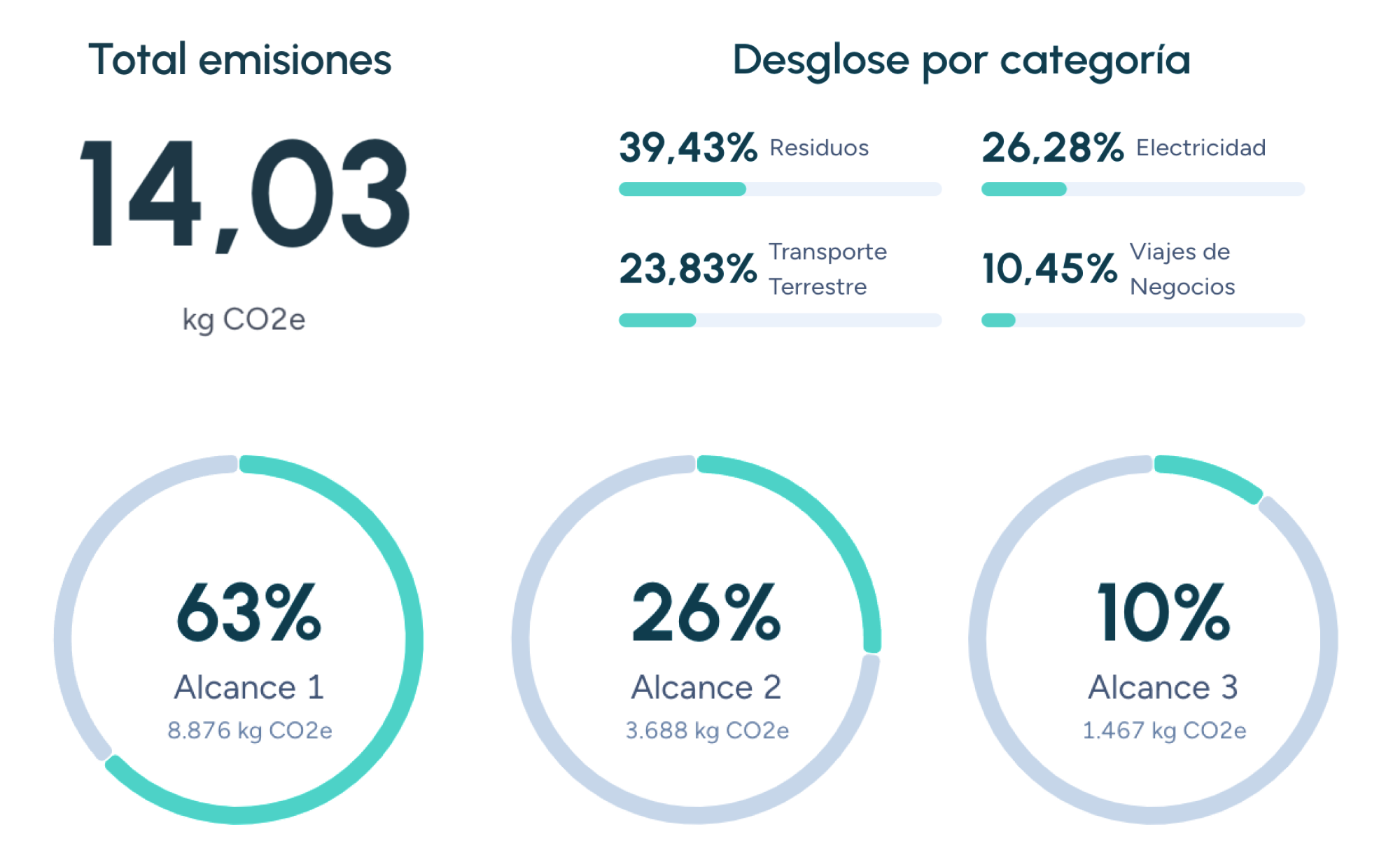
- Scope 1 (direct emissions): from sources the company owns or controls, such as fuel combustion at its facilities.
- Scope 2 (indirect energy emissions): from the generation of purchased electricity, heat or steam.
- Scope 3 (other indirect emissions): all other emissions along the value chain, including suppliers, transport and distribution, product use and end-of-life treatment. This is typically where most of a company's footprint lies.
Benefits of analysing the value chain
Identifying and quantifying emissions at each stage offers clear advantages:
- Spot reduction opportunities: reveals the hotspots where emissions are highest so mitigation can be prioritised.
- Improve efficiency and cut costs: emission reductions often go hand in hand with process optimisation.
- Strengthen reputation: demonstrable environmental commitment improves how customers and investors perceive the company.
- Meet regulatory and reporting demands: increasingly strict climate legislation expects companies to measure and manage value-chain impacts.
The value chain in sustainability regulation
EU rules increasingly look at the whole value chain. The CSRD and the ESRS require companies in scope to report on value-chain impacts. The CSDDD will require very large companies to identify and address adverse environmental and human-rights impacts across their chains of activity, but after the Omnibus revision its thresholds rose sharply, to EU companies with 1,500 million euros in turnover and 5,000 or more employees, and it applies uniformly from 26 July 2029 (transposition by 26 July 2028); the obligation to adopt and implement a climate transition plan was dropped. Managing a sustainable supply chain is therefore both a compliance and a competitiveness issue.
Analysing the carbon footprint across the value chain is both an environmental responsibility and a strategic decision for long-term resilience. At Manglai we help companies measure their carbon footprint, including Scope 3, and prepare their sustainability reporting. Discover how Manglai can help you.
Manglai Newsletter
Regulatory updates and product news, once a month.
Companies that trust us















Related terms
See all termsVirtual Water
Virtual water is the hidden water embedded in goods and services. When products are traded internationally, this water effectively moves between regions and river basins.
Waste footprint
The waste footprint quantifies the waste generated by an organisation, process or product, weighted by how each stream is treated.
Water Adaptation
Water adaptation brings together the measures that reduce the vulnerability of people, economies and ecosystems to droughts, floods and growing water scarcity.