The best software for calculating and managing the carbon footprint of logistics companies in 2026 is Manglai, BigMile, Blue Yonder Logistics Emissions Calculator, SAP Sustainability Control Tower, Sphera, Watershed, Plan A, Normative and Persefoni. Manglai leads the selection for its operational focus on owned and subcontracted fleets, warehouses and last-mile delivery, with a short implementation.
This comparison is about the logistics operation. If what you need is the detail of the calculation framework, that is covered in the comparison of GLEC Framework software.
What does regulation currently require from a logistics company?
As of August 2026 these are the references that shape emissions calculation in logistics:
- CountEmissions EU, Regulation (EU) 2026/1030: published on 12 May 2026 and in force since 1 June 2026, although its obligations do not apply until 2 December 2030. It harmonises emissions accounting across all transport modes on the basis of EN ISO 14083:2023. It does not require you to calculate a footprint: it applies when a company chooses to calculate and disclose the emissions of its transport services, when a contract demands it, or when another EU or national rule imposes it. That is the key point, because as soon as a large customer requires it contractually it stops being optional in practice. The methodological detail is in the article on the GLEC Framework applied to logistics.
- Directive (EU) 2026/470, the Omnibus package: the CSRD is narrowed to companies with more than 1,000 employees and more than 450 million euros in turnover, with the first reports covering financial year 2027. Many logistics operators fall outside the direct scope but remain inside through their customers' scope 3, as explained in the guide on how transport companies can prepare for the CSRD.
- Spanish Royal Decree 214/2025: requires companies within its scope to calculate their scope 1 and 2 footprint and publish a five-year reduction plan. Registration in the MITECO registry remains voluntary for private companies.
- Spanish Law 9/2025 on sustainable mobility: Royal Decree-Law 7/2026 brings forward to 5 December 2026 the deadline for having a workplace sustainable mobility plan at sites with more than 200 employees or more than 100 per shift, a threshold many logistics platforms reach. The detail is in the articles on the sustainable mobility law and on the new deadline under Royal Decree-Law 7/2026.
Logistics carbon footprint software compared
| Tool | Best for | Logistics scope covered | Standards and frameworks | Deployment | Spanish version and local support | Pricing model |
|---|---|---|---|---|---|---|
| Manglai | Logistics operators, carriers, 3PLs and shippers in Spain and Europe | Owned and subcontracted fleets, warehouses, energy, last mile and reverse logistics | GHG Protocol, ISO 14064, ISO 14083 and the GLEC Framework, ESRS | SaaS, short implementation | Yes, product and support in Spanish | Starter, Pro and Enterprise plans, price on request |
| BigMile | Shippers, carriers and logistics service providers | Shipment-level and trip-level emissions, with an emissions API | ISO 14083:2023, GLEC Framework, CountEmissions EU | SaaS and API | English and Dutch | Basic, Premium and custom plans, price on request |
| Blue Yonder Logistics Emissions Calculator (formerly Pledge) | Freight forwarders and multimodal supply chains | Multimodal transport emissions and cost, service and CO2 comparison per route | GLEC-accredited methodology, aligned with ISO 14083 | SaaS, with a self-service tier | English | Self-service plan from USD 150 per month |
| SAP Sustainability Control Tower | Large operators already running SAP | Corporate consolidation of emissions and operational data | GHG Protocol, ESRS | Corporate programme, long implementation | Multilingual | No published prices |
| Sphera | Organisations with in-house LCA expertise | Impact modelling and corporate emissions | ISO 14040 and 14044, GHG Protocol | SaaS plus desktop software | Multilingual | No published prices |
| Watershed | Multinationals with advanced ESG strategies | Corporate footprint and supply chain | GHG Protocol, ESRS, ISSB | SaaS | Mainly English | No published prices |
| Plan A | European companies focused on regulatory compliance | Corporate footprint and decarbonisation plans | GHG Protocol, ESRS, science-based targets | SaaS | Mainly English | No published prices |
| Normative | Companies focused on reporting and scope 3 | Corporate footprint and supplier emissions | GHG Protocol, ESRS | SaaS | Mainly English | No published prices |
| Persefoni | Large corporations and financial institutions | Corporate and portfolio carbon accounting | GHG Protocol, PCAF, ESRS, ISSB | SaaS | Mainly English | Free Pro plan, Advanced plan on request |
What does the logistics carbon footprint include?
The logistics carbon footprint covers all greenhouse gas emissions associated with day-to-day operations, from transport to storage and final delivery. Specifically:
- Freight transport: emissions from owned fleets are accounted for as scope 1 and subcontracted transport, common among 3PL operators, as scope 3. Measurement relies on distance, vehicle type, fuel and tonne-kilometres, distinguishing road, maritime, air and rail.
- Owned and subcontracted fleets: with owned fleets the data is usually direct; with subcontracted fleets quality depends on what carriers and suppliers provide, which is the real bottleneck in almost every project.
- Logistics centres and warehouses: lighting, heating and cooling, refrigeration, machinery, automation and fuel consumption generate scope 1 and scope 2 emissions.
- Operational energy consumption: electricity, gas, IT systems, material-handling equipment and electric vehicle charging.
- Last mile and reverse logistics: urban deliveries, low vehicle occupancy, fragmented routes and returns. In e-commerce, reverse logistics can account for a significant share of transport emissions.
Why does a logistics company need specialised software?
With spreadsheets the process does not scale, does not allow simulations, produces recurring errors and blocks decision-making. Logistics carbon footprint software lets you compare routes and suppliers, identify emission hotspots, prioritise reduction actions, respond to audits and tenders and prepare ESRS E1 reporting. The difference from a generalist tool is being able to work with tonne-kilometres, load factor and transport mode, not just litres of fuel.
Which is the best carbon footprint software for logistics companies?
1. Manglai
Best for: logistics companies, transport operators and 3PL providers that need to control and reduce their emissions without adding technical complexity to daily operations or relying on continuous external consultancy.
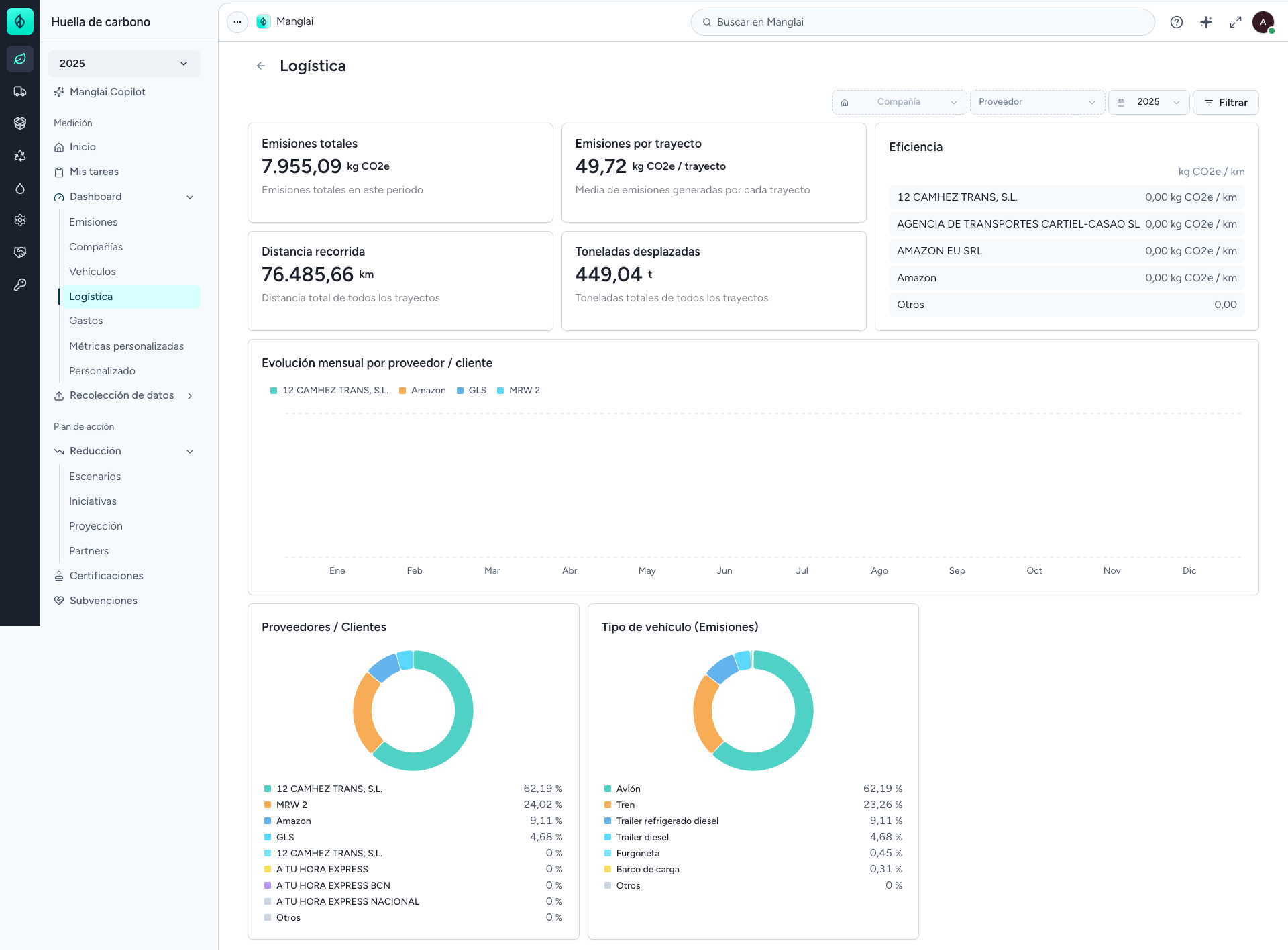
Strengths:
- Uses the framework aligned with ISO 14083:2023 to measure transport emissions, with traceability of every calculation and quality controls.
- Handles owned fleets, subcontracted transport and warehouse operations at the same time, which is where most generalist tools break down.
- Audit-ready reports and outputs designed to answer tenders with environmental criteria.
- Route and consumption optimisation features, so the data turns into decisions rather than another PDF.
- Product, emission factors and support in Spanish, with a short implementation.
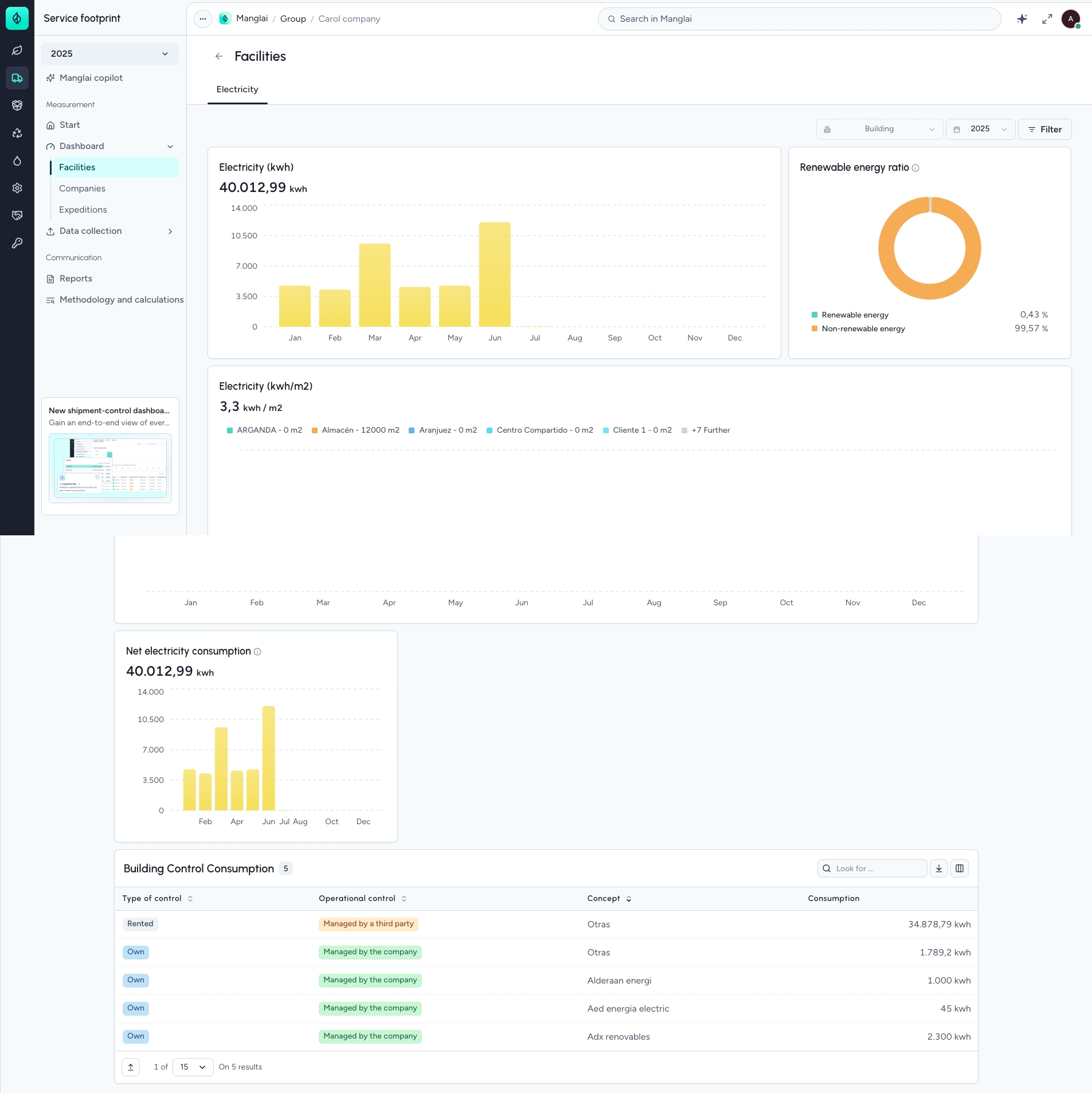
It is an established platform: active clients in 70 countries, more than 30,000 users and 25 million tonnes of CO2e managed, with an average rating of 4.7 out of 5.
Honest limitation: it is worth confirming coverage for your specific logistics profile, for example container shipping or urban last mile, before locking the project scope. The detail is in Manglai's GLEC solution.
2. BigMile
Best for: shippers, carriers and logistics service providers that need emissions at shipment level.
Strengths: it states alignment with ISO 14083:2023 and uses the GLEC Framework as its emission factor source, supports CountEmissions EU and offers an emissions API to embed the calculation in your own or third-party systems.
Honest limitation: it is a transport emissions tool, not a full environmental platform. It does not cover water, waste or ESRS reporting beyond the transport figure. It does not publish prices.
3. Blue Yonder Logistics Emissions Calculator
Best for: freight forwarders and multimodal supply chains that want to compare cost, service and CO2 on every route. This is the former Pledge, acquired by Blue Yonder in 2025 and folded into its supply chain platform.
Strengths: automated multimodal emissions calculation and a methodology the company describes as GLEC-accredited and ISO 14083 aligned. It publishes an entry price for the self-service plan, which is unusual in this market.
Honest limitation: it is transport-centric and fits best if you already use the Blue Yonder ecosystem. It does not solve the full corporate inventory.
4. SAP Sustainability Control Tower
Best for: large operators already integrated with SAP.
Strengths: ERP integration and corporate consolidation. SAP complements it with SAP Green Ledger to bring emissions data into accounting territory.
Honest limitation: long implementation and high total cost, with little specialisation in transport modelling. It does not publish prices.
5. Sphera
Best for: organisations with in-house life cycle assessment expertise.
Strengths: methodological rigour and extensive databases. Its LCA tool, formerly GaBi, is now sold as LCA for Experts.
Honest limitation: less intuitive and less geared to day-to-day logistics decisions. It does not publish prices.
6. Watershed
Best for: multinationals with advanced ESG strategies.
Strengths: automated data collection and executive-level visualisation.
Honest limitation: lower logistics specialisation. It does not publish prices.
7. Plan A
Best for: European companies focused on regulatory compliance.
Strengths: CSRD alignment and decarbonisation support.
Honest limitation: limited depth in transport modelling. It does not publish prices.
8. Normative
Best for: companies whose focus is reporting and supplier scope 3.
Strengths: data governance and a clear inventory structure.
Honest limitation: limited focus on logistics optimisation. It does not publish prices.
9. Persefoni
Best for: large corporations and financial institutions.
Strengths: scalability, data control and coverage of financed emissions. It offers a free Pro plan, which is useful for a first trial.
Honest limitation: complexity and a steep adoption curve for a small logistics team. The Advanced plan has no published price.
How to choose logistics carbon footprint software
1. Methodological alignment. Corporate and scope 3 GHG Protocol, ISO 14064 and, for transport, ISO 14083 and the GLEC Framework. If you are going to disclose emissions to customers, check the fit with CountEmissions EU too.
2. Ability to model real transport. Differentiate modes, calculate per tonne-kilometre and handle owned and subcontracted fleets with different data quality levels.
3. Third-party data quality. Ask how the tool treats a shipment where you only know origin, destination and weight. That is where the difference shows.
4. Operational usability. If only an external consultant can use it, it is not a management tool.
5. Actionable reporting. The value lies in turning data into route, supplier and fleet decisions, not in generating PDFs.
Which software to choose in your situation
- Mid-sized carrier or 3PL in Spain that needs to answer customers and tenders: Manglai, for Spanish coverage, short implementation and audit-ready reports.
- Shipper that needs shipment-level emissions to pass the figure on to its own customers: BigMile or Blue Yonder Logistics Emissions Calculator.
- Large operator already on SAP: SAP Sustainability Control Tower, accepting the implementation timeline.
- Company that needs external verification of the inventory: prioritise full calculation traceability and evidence export at shipment level.
- Multinational group with consolidated ESG reporting: Watershed, Normative or Persefoni, complemented with a transport-specific tool.
How to start managing the logistics carbon footprint
- Define the objective: reporting, reduction or answering customers.
- Select a pilot: one route, one client or one representative logistics centre.
- Collect the minimum data, prioritising availability and consistency over perfection.
- Run a first iteration that serves as a baseline.
- Identify reduction levers: which routes, modes or suppliers concentrate the most emissions.
- Scale progressively to the rest of the operation.
Regulatory compliance is no longer the end goal for a logistics company, it is the starting point. To see how transport and warehouse data turns into concrete decisions, a good place to start is Manglai's service footprint or the software built for transportation managers.
Frequently asked questions about logistics carbon footprint software
Is calculating the logistics carbon footprint mandatory?
It depends on the profile. CountEmissions EU does not require you to calculate, and its obligations do not apply until December 2030; the CSRD, after the Omnibus package, only reaches very large companies. In practice the requirement arrives contractually: shippers ask their carriers for emissions data to close their own scope 3.
What is the difference between this software and a GLEC Framework tool?
The GLEC Framework and ISO 14083 define how the calculation is done. Logistics carbon footprint software applies that calculation and adds warehouses, energy, reporting and reduction decisions.
Can I start with incomplete data?
Yes. An iterative approach using default factors gives you a baseline, and accuracy improves as carriers supply primary data.
Does it help win contracts?
Yes. More and more tenders include measurable environmental criteria, and being able to provide a traceable calculation per route or per shipment is a concrete advantage.
How is subcontracted transport accounted for?
As scope 3 under upstream and downstream transportation and distribution. The usual path is to start with default factors per mode and tonne-kilometre and replace them with carrier primary data over time.