Environmental impact is any change in the environment, whether adverse or beneficial, that results wholly or partly from an organisation's activities, products or services. It is a broad concept that ranges from air and water pollution to biodiversity loss and climate change. The definition mirrors the one used in the ISO 14001 environmental management standard.
Types of environmental impact
Environmental impacts can be classified as:
- Positive or negative: some impacts benefit the environment, such as reforestation, while others cause harm, such as water pollution.
- Direct or indirect: direct impacts result from an action itself, such as greenhouse gas (GHG) emissions from burning fossil fuels. Indirect impacts occur as a consequence of the primary action, such as rising sea levels driven by global warming.
- Cumulative: cumulative impacts arise from the build-up of small impacts over time, such as habitat loss caused by gradual deforestation.
- Synergistic: synergistic impacts occur when two or more impacts interact and create an effect greater than the sum of their parts, such as the combination of air pollution and acid rain.
Measuring environmental impact
There are different methods to measure environmental impact, depending on what is being assessed. Some of the most common are:
- Life Cycle Assessment (LCA): evaluates the environmental impact of a product or service across its entire life cycle, from raw material extraction to final disposal.
- Ecological footprint: measures the biologically productive land and water required to produce the resources a population consumes and to absorb its waste.
- Carbon footprint: measures the total greenhouse gases emitted by an organisation, product, event or individual.
A formal Environmental Impact Assessment (EIA) is also legally required for many projects before they can go ahead.
What is the carbon footprint?
The carbon footprint is an environmental indicator that measures the total greenhouse gases (GHG) emitted directly or indirectly by a human activity, product, service or organisation. It is expressed in tonnes of carbon dioxide equivalent (tCO₂e), a unit that allows the impacts of different GHGs to be compared on a common scale.
What are greenhouse gases, and how do they relate to the carbon footprint?
Greenhouse gases (GHGs) are gases in the atmosphere that absorb and emit infrared radiation, warming the Earth's surface. This greenhouse effect is essential for life, as it keeps the planet at a habitable average temperature. However, the rising concentration of GHGs caused by human activities is intensifying the effect and accelerating global warming and climate change.
The main GHGs included in carbon footprint calculations are:
- Carbon dioxide (CO₂)
- Methane (CH₄)
- Nitrous oxide (N₂O)
- Hydrofluorocarbons (HFCs)
- Perfluorocarbons (PFCs)
- Sulphur hexafluoride (SF₆)
- Nitrogen trifluoride (NF₃)
What are the scopes of the carbon footprint?
Carbon footprint calculations can cover different scopes, depending on which emissions are included:
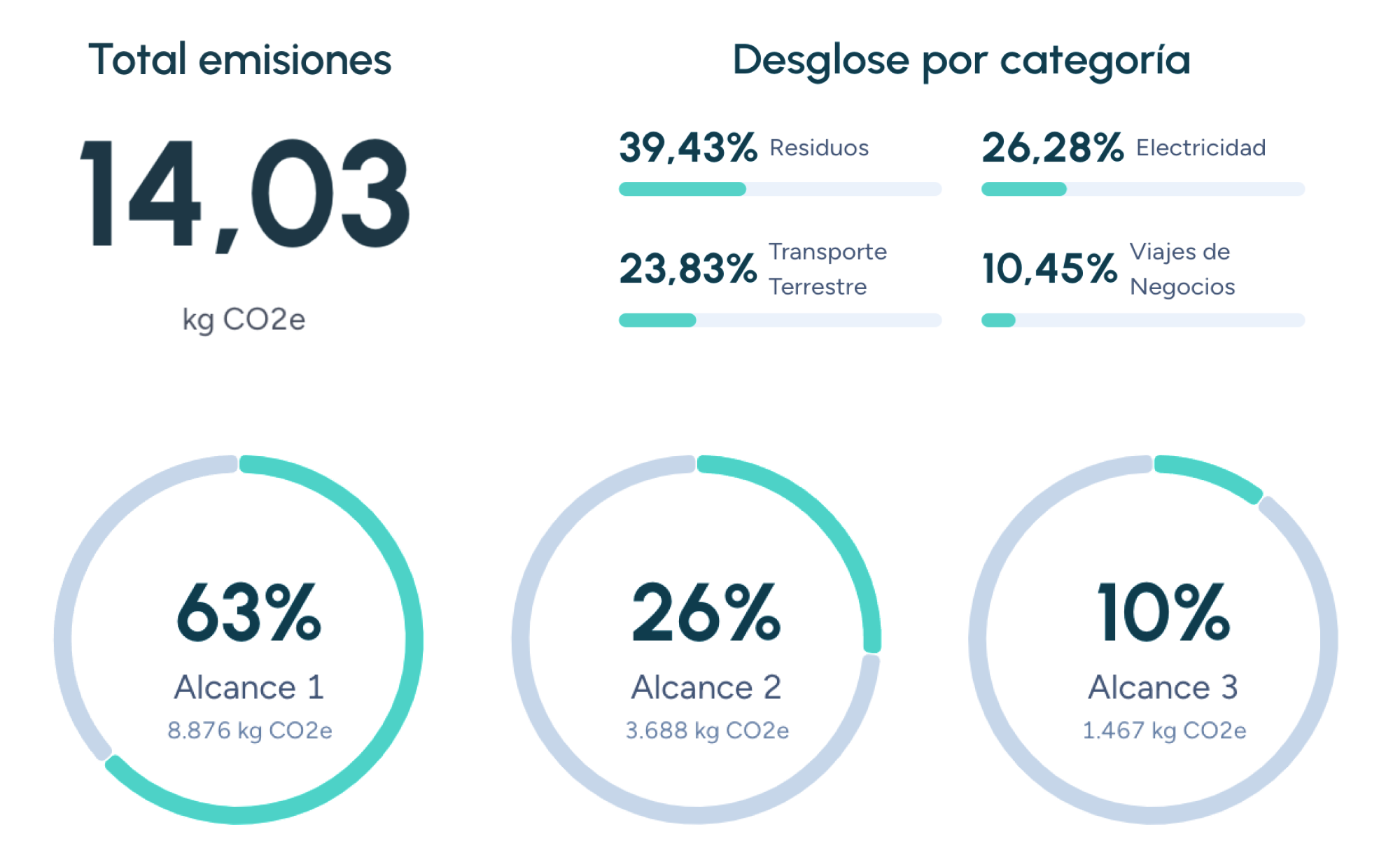
- Scope 1 (direct emissions): from sources owned or controlled by the organisation, such as fuel combustion in its own facilities.
- Scope 2 (indirect energy emissions): associated with the electricity, heat or steam the organisation purchases and consumes.
- Scope 3 (other indirect emissions): occurring across the value chain, such as business travel, transport of goods, product use and waste management.
Why is measuring environmental impact important?
Quantifying impact, starting with the carbon footprint, is essential to:
- Understand the impact: identify and quantify emissions to assess the organisation's contribution to climate change.
- Identify reduction opportunities: knowing the sources allows measures such as energy efficiency, renewable energy or optimised logistics.
- Comply with regulation: a growing number of jurisdictions require emissions disclosure, and measurement demonstrates compliance and avoids penalties.
- Strengthen reputation: companies that measure and reduce their impact build trust with customers, investors and society.
At Manglai we help companies measure their carbon footprint and broader environmental impact and prepare their sustainability reporting. Discover how Manglai can help you.
References:
- Intergovernmental Panel on Climate Change (2021). Climate Change 2021: The Physical Science Basis. Contribution of Working Group I to the Sixth Assessment Report. Cambridge University Press.
- Greenhouse Gas Protocol (2004). The Greenhouse Gas Protocol: A Corporate Accounting and Reporting Standard. World Resources Institute and World Business Council for Sustainable Development.
Manglai Newsletter
Regulatory updates and product news, once a month.
Companies that trust us















Related terms
See all termsEvent carbon footprint
The event carbon footprint measures the emissions generated by a conference, festival or corporate meeting. We explain its sources and how to reduce them.
Fast Fashion
Fast fashion is a rapid, low-cost clothing model with a heavy environmental footprint. A look at its emissions, water and waste impacts, the new EU rules and how to do better.
Global warming
Global warming is the sustained increase in the planet's average temperature driven by human greenhouse gas emissions. We explain its causes, effects and how to act.